
In co-owned properties, willingness alone does not get works underway


 4 min
reading time
Energy efficiency retrofits require cooperation on a collective scale. Yet it is precisely in co-owned developments, where decisions must be taken jointly, that the hurdle is highest. As a reminder, the 2026 Observatoire Cetelem de l’habitat specifically surveyed co-owners across eight countries. The analysis of decision-making in co-owned properties, both here and in the following section on financing, focuses on the four target markets: France, Italy, Spain and Belgium.
INDIVIDUALLY, CO-OWNERS ARE RECEPTIVE TO ENERGY RETROFITS
Taken individually, co-owners are well-versed in energy retrofitting. Indeed, 2 out of 3 consider themselves informed about retrofit solutions, are interested in them and are aware of both potential energy savings and funding options. The topic is therefore neither ignored nor misunderstood.
However, this level of awareness is uneven, particularly across different financial profiles: information levels rise to 79% in affluent co-owned developments, but fall to around 50% in more financially constrained properties. Property size follows the same trend: co-owners in small properties with fewer than five units report being significantly better informed (around 75%) than larger developments of more than twenty units (around 60%).
Fig. 56 – Co-owners’ information and interest regarding energy efficiency retrofits
Download this infographic for your presentations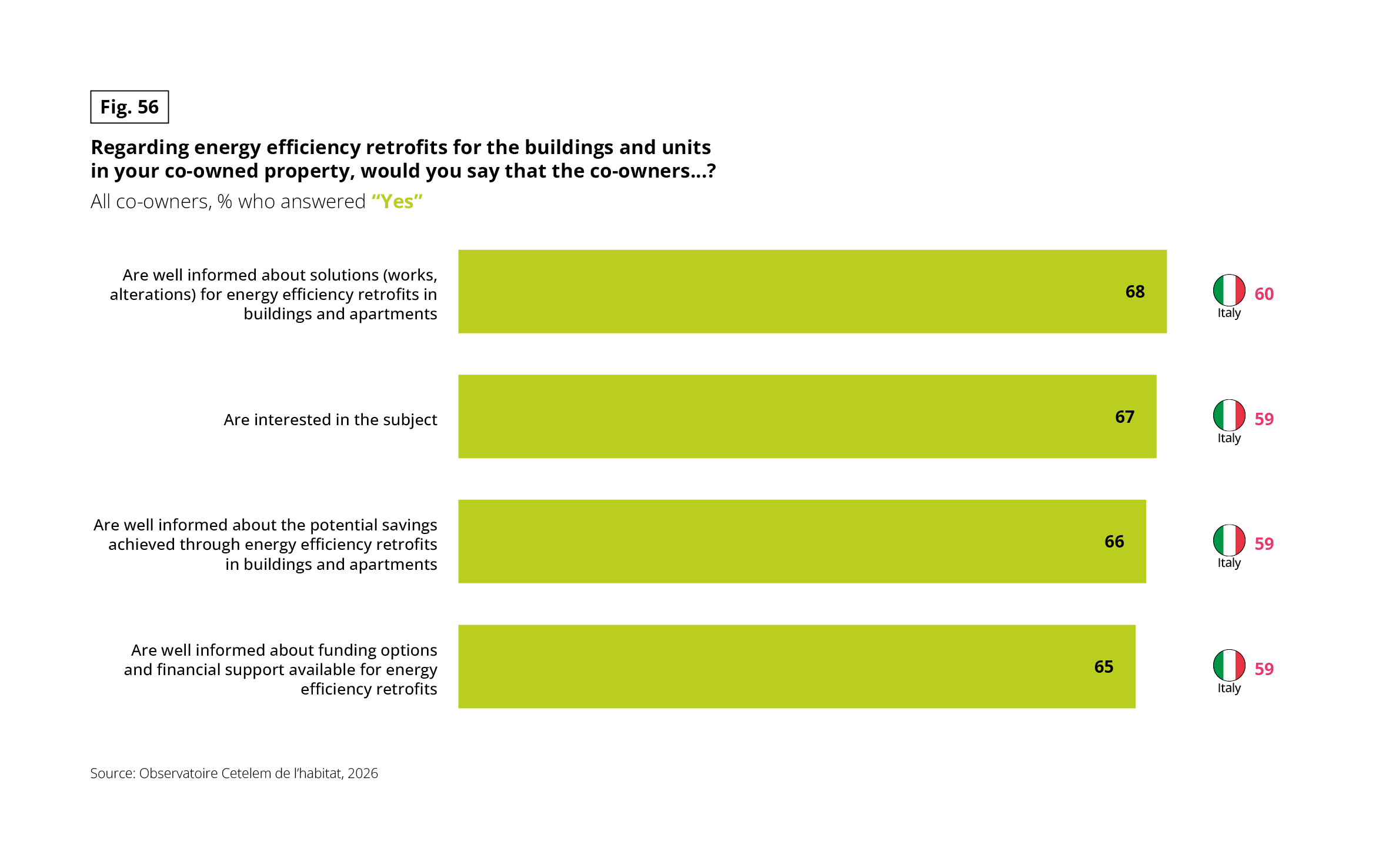 Horizontal bar chart with an Italy comparison. Question: “Regarding energy efficiency retrofits for the buildings and units in your co-owned property, would you say that the co-owners…?” Base: all co-owners, % answering “Yes”. Italy’s value is shown beside each bar. Source: Observatoire Cetelem de l’habitat, 2026.
Data in the form total / Italy:
• Are well informed about solutions (works, alterations) for energy efficiency retrofits in buildings and apartments: 68 / 60
• Are interested in the subject: 67 / 59
• Are well informed about the potential savings achieved through energy efficiency retrofits in buildings and apartments: 66 / 59
• Are well informed about funding options and financial support available for energy efficiency retrofits: 65 / 59
Italy is below the total on all four items, by 6 to 8 points.
And the stakes are widely recognised: 87% of co-owners consider renovation important, with Belgium leading the four surveyed countries, ahead of Spain, France and Italy. Yet, much like awareness, conviction follows financial capacity and property size: energy retrofitting is judged important by 94% of affluent co-owned developments compared to 77% of the most financially constrained, and by 91% of small properties versus 82% of larger ones.
Co-owners themselves are the first to demand higher standards: nearly 7 in 10 believe that not enough is being done regarding at least one aspect of their building, with energy efficiency retrofits topping the list of shortcomings (38%, rising to 47% in Italy).(1) Readiness, then, is not the issue: informed, convinced and eager for change, co-owners individually possess every reason to move forward.
(1) Source : Observatoire Cetelem de l’habitat, 2026. “Within your co-owned property, generally speaking, do you feel that too much, not enough, or just the right amount is being done to improve the condition of the building regarding energy efficiency retrofits?”
Fig. 57 – Priority given to energy efficiency retrofits in co-owned properties
Download this infographic for your presentations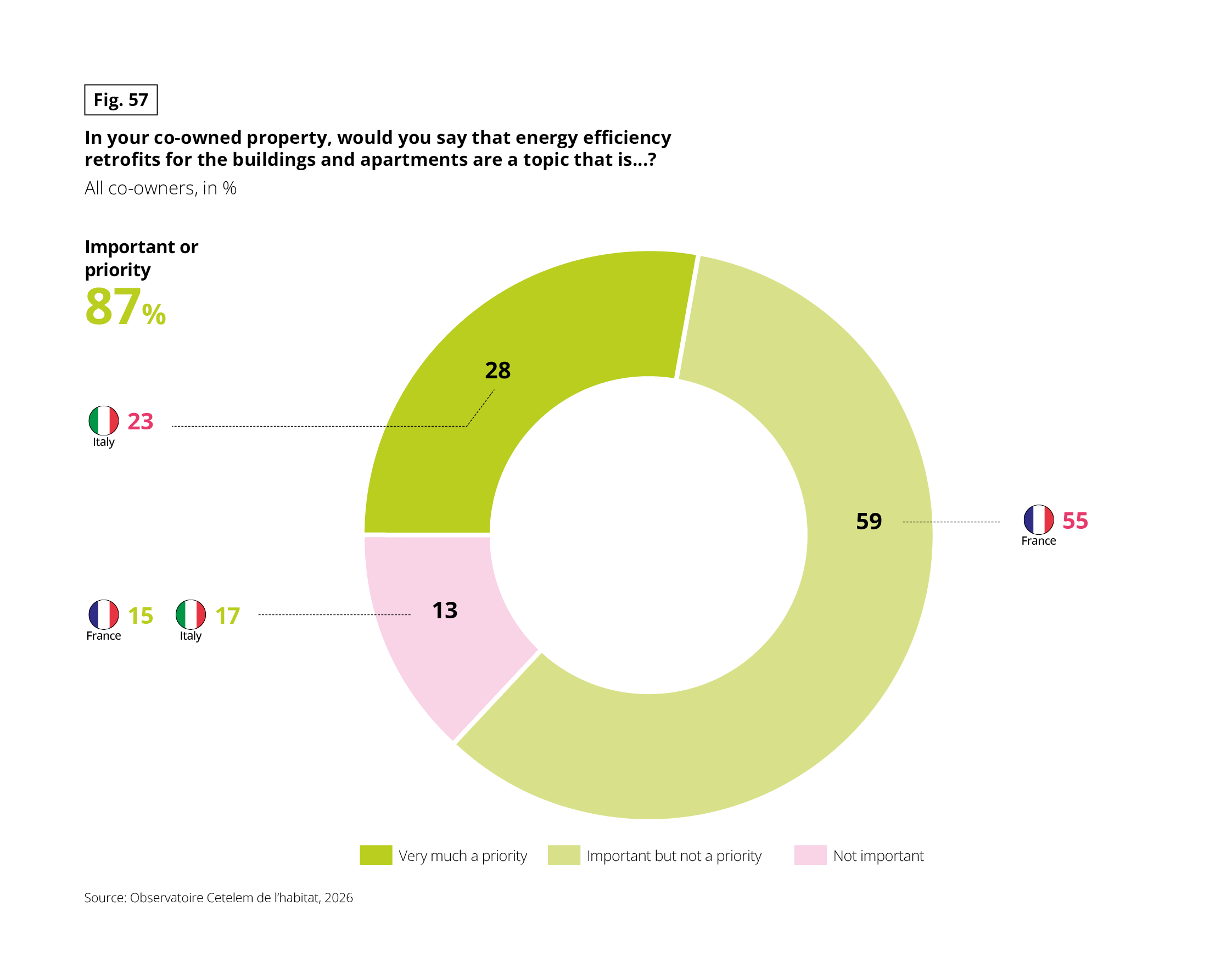 Donut chart. Question: “In your co-owned property, would you say that energy efficiency retrofits for the buildings and apartments are a topic that is…?” Base: all co-owners, in %. Source: Observatoire Cetelem de l’habitat, 2026.
Results: very much a priority 28%; important but not a priority 59%; not important 13%. In total, 87% say it is important or a priority.
Country comparisons shown on the chart: Italy is 5 points below the total on “very much a priority” (23%), and France is below on “important but not a priority” (55%). For “not important”, France (15%) and Italy (17%) are above the total.
COLLECTIVELY, AGREEMENT ON ENERGY EFFICIENCY RETROFITS BECOMES MORE COMPLEX
While co-owners are ready to act when making decisions for themselves, momentum flags as soon as they must act as a group and make a commitment. In principle, 6 in 10 believe their neighbours favour retrofit projects, but only half consider that they reach agreement easily.
The same divide observed with information levels re-emerges here: agreement increases with financial ease and smaller property size (64% in favour in affluent co-owned developments, 63% in properties with fewer than five units), whereas in large complexes and financially constrained properties, projects prove more divisive (62% in lower-income co-owned properties, 55% in developments with more than 20 units).
Fig. 58 – Co-owners’ views on energy efficiency retrofit projects
Download this infographic for your presentations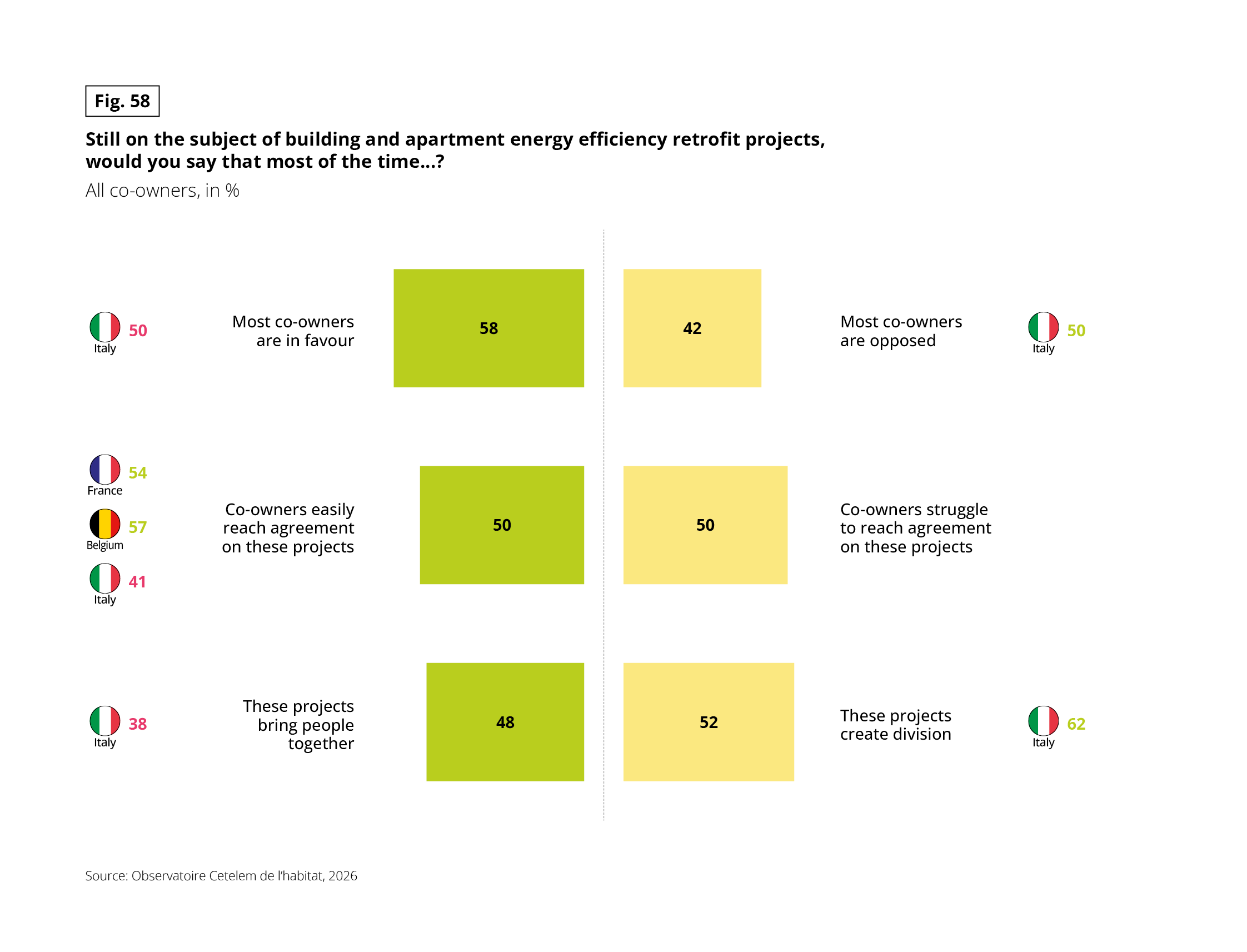 Three pairs of opposing bars. Question: “Still on the subject of building and apartment energy efficiency retrofit projects, would you say that most of the time…?” Base: all co-owners, in %. Country values are shown beside some bars. Source: Observatoire Cetelem de l’habitat, 2026.
Results, in the form left statement / right statement:
• Most co-owners are in favour 58% / most co-owners are opposed 42%. Italy: 50% / 50%.
• Co-owners easily reach agreement on these projects 50% / co-owners struggle to reach agreement on these projects 50%. Country values for the first statement: France 54%, Belgium 57%, Italy 41%.
• These projects bring people together 48% / these projects create division 52%. Italy: 38% / 62%.
A majority are in favour of retrofits, but opinion is split on agreement and on whether projects unite or divide. Italy is the most negative, with 62% saying projects create division and only 41% finding agreement easy.
RETROFITTING IS SLOW TO MOVE FROM INTENTION TO ACTION
Actual progress, however, is struggling to follow suit. When asked about their real stage of advancement, barely more than half of co-owners have initiated an energy efficiency retrofit process, with most remaining at the audit stage.
When it comes to concrete action, Belgium (29%) and France (26%) are ahead of Spain (21%) and Italy (19%) in terms of completed works or formally approved projects.
In line with previous findings, financial resources and property size once again exert an influence in the same direction: affluent co-owned developments and smaller properties are significantly more likely to be engaged in projects, whereas non-decision dominates in large, financially constrained complexes, with the share of properties undertaking works dropping as building size increases.
Building age creates a final line of fracture, one that widens as properties move further down the retrofit path. While the difference is minor for works already underway (28% for buildings under five years old versus 21% for pre-2005 structures), it becomes stark when looking at total inaction: pre-2005 developments account for nearly twice as many stalled units as newer stock. The finding is both consistent and paradoxical: precisely where energy stakes are highest (in the oldest, largest, and most financially constrained properties), retrofitting is most often a topic that is never even raised.
Fig. 59 – Current progress of energy efficiency retrofits in Cc-owned properties across Europe
Download this infographic for your presentations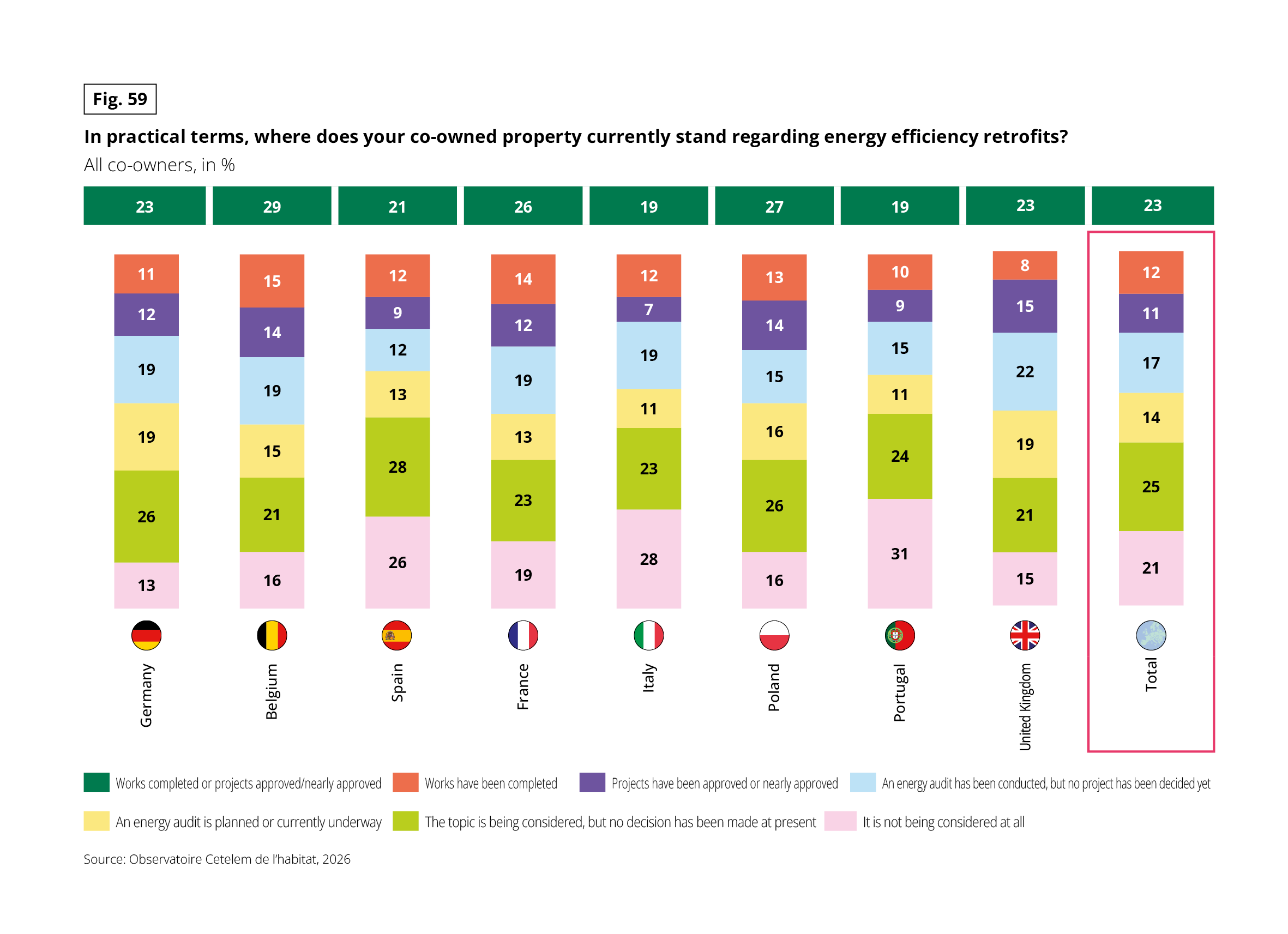 The infographic presents the reported stage of energy efficiency retrofit projects in co-owned properties across eight European countries and the overall European sample. Each vertical stacked column represents one country or the total. The segments distinguish seven stages, from completed or approved projects to retrofits that are not being considered. All figures are percentages of co-owners. The source is the Observatoire Cetelem de l’habitat, 2026.
The legend identifies the following categories:
• Works completed, or projects approved or nearly approved.
• Works completed.
• Projects approved or nearly approved.
• An energy audit has been conducted, but no project has yet been decided.
• An energy audit is planned or currently underway.
• Energy efficiency retrofits are being considered, but no decision has been made.
• Energy efficiency retrofits are not being considered at all.
Country results, in the order shown in the legend:
• Germany: 23%, 11%, 12%, 19%, 19%, 26% and 13%.
• Belgium: 29%, 15%, 14%, 19%, 15%, 21% and 16%.
• Spain: 21%, 12%, 9%, 12%, 13%, 28% and 26%.
• France: 26%, 14%, 12%, 19%, 13%, 23% and 19%.
• Italy: 19%, 12%, 7%, 19%, 11%, 23% and 28%.
• Poland: 27%, 13%, 14%, 15%, 16%, 26% and 16%.
• Portugal: 19%, 10%, 9%, 15%, 11%, 24% and 31%.
• United Kingdom: 23%, 8%, 15%, 22%, 19%, 21% and 15%.
• European total: 23%, 12%, 11%, 17%, 14%, 25% and 21%.
The first category is labelled “Works completed or projects approved/nearly approved” in the legend, while the next two categories distinguish completed works from approved or nearly approved projects. The displayed total for these categories should be interpreted according to the original survey’s category definitions rather than treated as a new combined figure.
The overall European results indicate that 25% are considering retrofits without having made a decision, while 21% are not considering them at all. Portugal has the highest share of respondents who are not considering retrofits, at 31%. Spain has the highest share reporting that an audit is planned or underway, at 13%, while Belgium has the highest share reporting completed works or projects approved or nearly approved, at 29%.
When they look ahead despite these obstacles, co-owners show interest in a broad array of works. External wall insulation tops the priority list (36%), ahead of communal solar panels and comprehensive retrofits (both at 34%), followed by roof insulation (33%).
Each country tailors its priorities to its climate: Italy overwhelmingly favours solar power (45%), Spain focuses on wall insulation (42%), France values wall insulation alongside comprehensive retrofits, while leading on EV charging points (27%), and Belgium splits its support between solar energy and roof insulation.
Fig. 60 – Energy efficiency retrofit projects prioritised by co-owners
Download this infographic for your presentations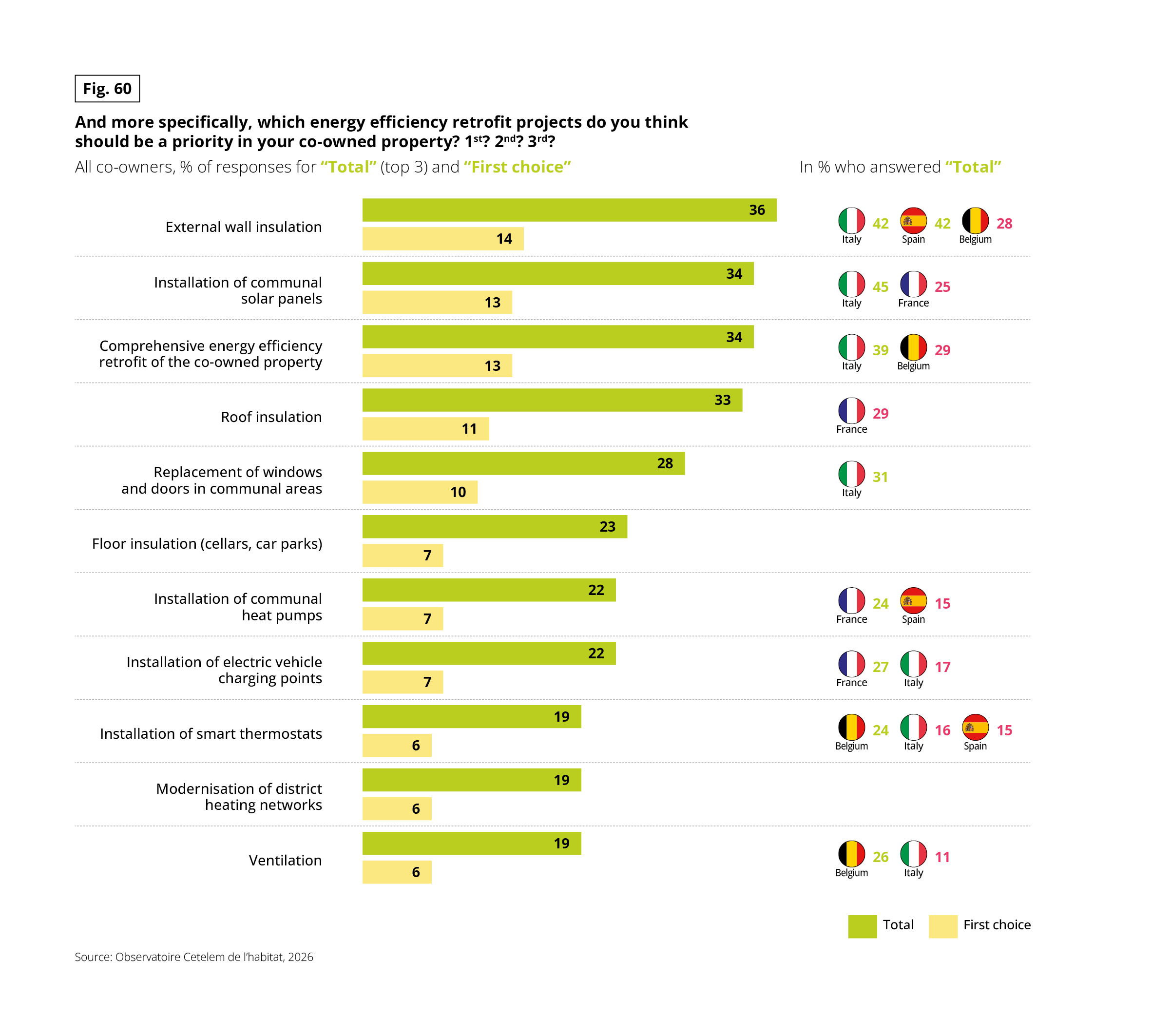 The infographic ranks eleven types of energy efficiency retrofit projects according to co-owners’ priorities for their jointly owned property. The green bars represent the percentage including each project among their top three choices, labelled “Total”. The yellow bars represent the percentage selecting each project as their first choice. Selected country comparisons appear on the right. All figures are percentages. The source is the Observatoire Cetelem de l’habitat, 2026.
Overall results, from highest to lowest total:
• External wall insulation: 36% in the top three; 14% as first choice.
• Installation of communal solar panels: 34%; 13%.
• Comprehensive energy efficiency retrofit of the co-owned property: 34%; 13%.
• Roof insulation: 33%; 11%.
• Replacement of windows and doors in communal areas: 28%; 10%.
• Floor insulation in cellars and car parks: 23%; 7%.
• Installation of communal heat pumps: 22%; 7%.
• Installation of electric vehicle charging points: 22%; 7%.
• Installation of smart thermostats: 19%; 6%.
• Modernisation of district heating networks: 19%; 6%.
• Ventilation: 19%; 6%.
Selected country comparisons for the total top-three responses:
• External wall insulation: Italy 42%, Spain 42%, Belgium 28%.
• Communal solar panels: Italy 45%, France 25%.
• Comprehensive energy efficiency retrofit: Italy 39%, Belgium 29%.
• Roof insulation: France 29%.
• Replacement of windows and doors in communal areas: Italy 31%.
• Communal heat pumps: France 24%, Spain 15%.
• Electric vehicle charging points: France 27%, Italy 17%.
• Smart thermostats: Belgium 24%, Italy 16%, Spain 15%.
• Ventilation: Belgium 26%, Italy 11%.
External wall insulation is the highest-ranked project overall, both in the top-three responses and as a first choice. Communal solar panels and comprehensive retrofits share second place in the top-three responses. The lowest overall figures are shared by smart thermostats, modernisation of district heating networks and ventilation, each selected by 19% of co-owners among their top three priorities.