
Almost all good between generations


 2 min
reading time
2 min
reading time
GOOD RELATIONS
Europeans agree that fears of dispute between younger and older generations are unjustified.
6 out of 10 said that intergenerational relations were good. Germany and Romania were the only countries where this view was not held by a majority of people.
Conversely, Sweden and the UK strongly supported it.
France was about average. These intergenerational relationships are sustained by mutual support that reflects the needs and ‘strengths’ of each age group.
It’s up to younger generation to help senior citizens with technology and digital tools, and it’s up to the older generation to pass on the know-how and skills they have acquired over the years. Young people also have an important role to play in the area of health, while seniors need to get involved in human relations and financial support (see part 4).This makes the role and impact of senior citizens within society as a whole all the more important, reinforcing the fact that they are an asset for a country.
Fig 10 – Perceived quality of intergenerational relationships
Download this infographic for your presentations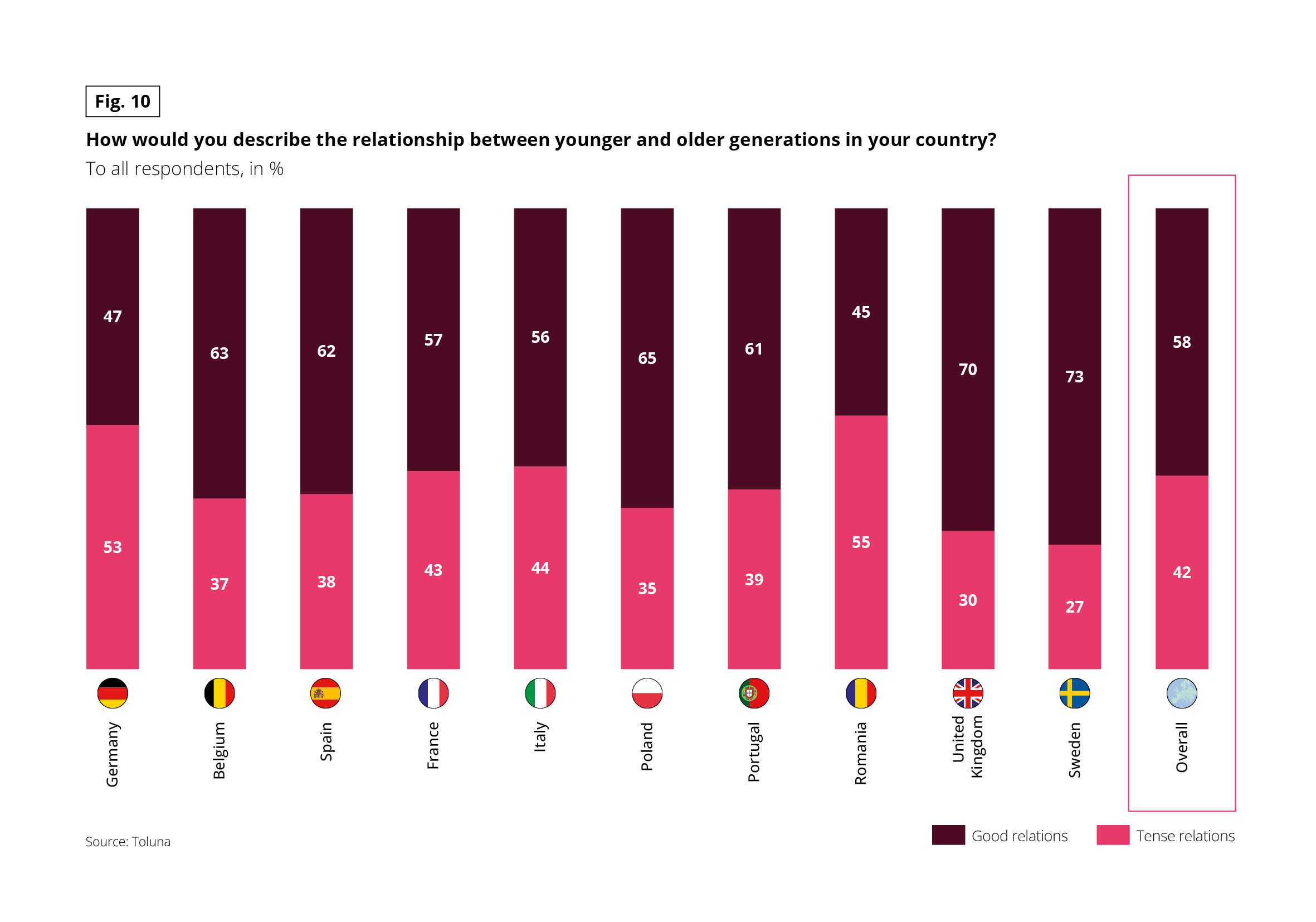 The graph measures the perception of relationships between young and older generations.
Key Visual Elements Graph with vertical stacked bars by country.
Data (good relationships)
Germany: 47%
Belgium: 63%
Spain: 62%
France: 57%
Italy: 56%
Poland: 65%
Portugal: 61%
Romania: 45%
United Kingdom: 70%
Sweden: 73%
All: 58%
Main Finding The majority of countries report positive intergenerational relationships, with particularly high levels in Sweden and the United Kingdom.
Source: Toluna
The graph measures the perception of relationships between young and older generations.
Key Visual Elements Graph with vertical stacked bars by country.
Data (good relationships)
Germany: 47%
Belgium: 63%
Spain: 62%
France: 57%
Italy: 56%
Poland: 65%
Portugal: 61%
Romania: 45%
United Kingdom: 70%
Sweden: 73%
All: 58%
Main Finding The majority of countries report positive intergenerational relationships, with particularly high levels in Sweden and the United Kingdom.
Source: Toluna
CONCERN FOR CHILDREN
This concern may be due to the deeper discussions that are now part of intergenerational relations, to a greater extent than several decades ago.
6 out of 10 seniors are concerned about their children’s professional future. This concern has remained relatively stable over the last 10 years, and is very apparent in Portugal, Sweden, Poland and Romania, but less so in Germany.
Fig 11 – Concern of seniors for the future of their children
Download this infographic for your presentations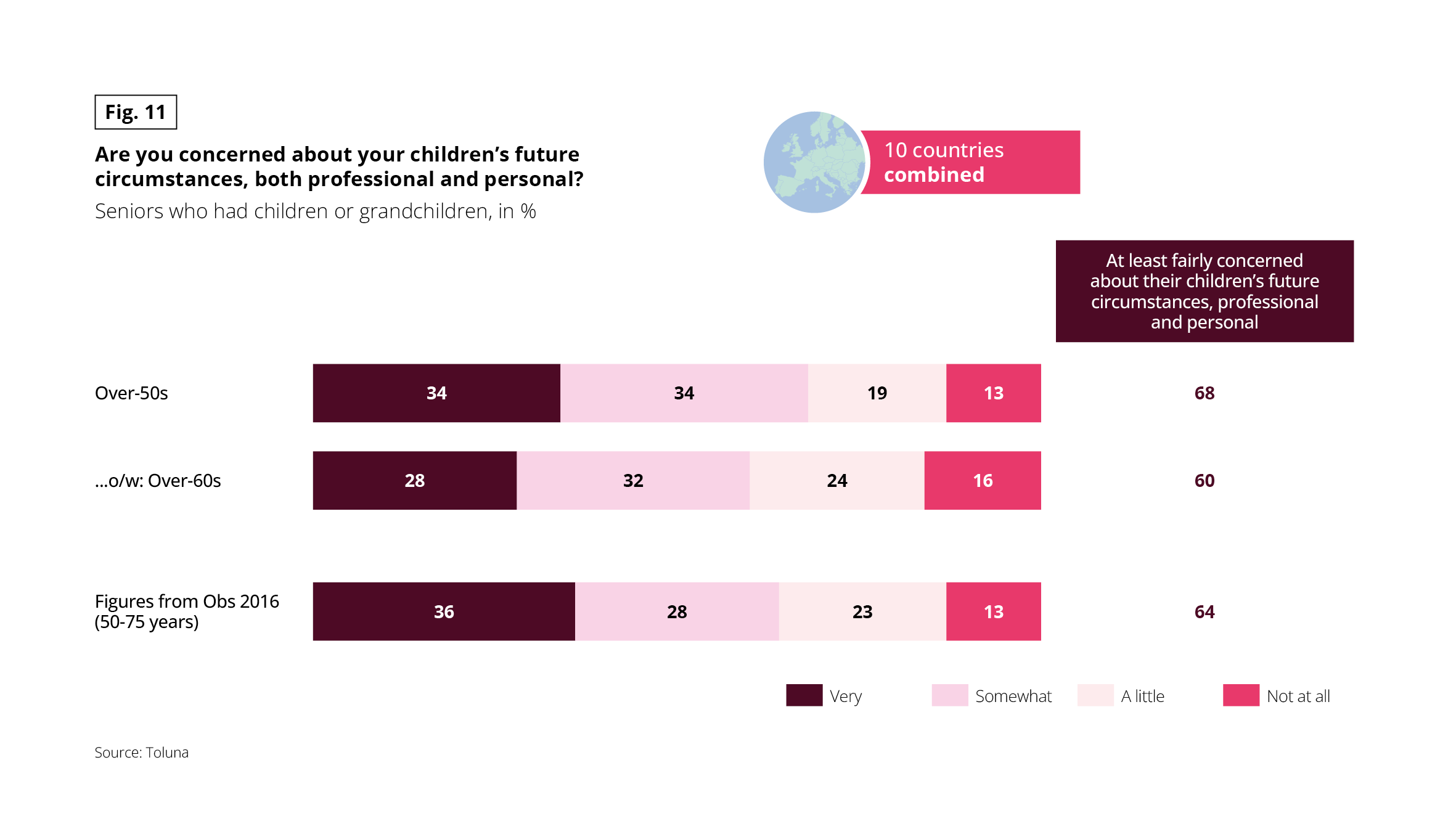 The graph analyzes the degree of concern of seniors with children or grandchildren about their professional and personal future.
Data
50 years and older: 68% at least quite concerned
Including 60 years and older: 60%
Reminder 2016 (50-75 years): 64%
Main Finding A majority of seniors express significant concern for the future of their children, with a slightly lower level among the oldest.
Source: Toluna
The graph analyzes the degree of concern of seniors with children or grandchildren about their professional and personal future.
Data
50 years and older: 68% at least quite concerned
Including 60 years and older: 60%
Reminder 2016 (50-75 years): 64%
Main Finding A majority of seniors express significant concern for the future of their children, with a slightly lower level among the oldest.
Source: Toluna
Les chiffres clés
- 62 years the average age at which people become senior citizens
- 7 out of 10 Europeans think that senior citizens are an asset for a country
- 85% think that the ageing of the population is a national issue
- 8 out of 10 seniors are concerned about the negative impact of ageing on the healthcare system
- 6 out of 10 Europeans consider intergenerational relations to be satisfactory6 out of 10 seniors are worried about their children’s professional future