
Deciding together: between genuine satisfaction and measured enthusiasm


 5 min
reading time
CO-OWNERSHIP: WHO IS AT THE HELM ACROSS EUROPE?
We come at last to the heart of the matter: the moment when co-ownership ceases to be merely a residential backdrop and becomes a decision-making engine. The following table compares eight European legal frameworks based on two straightforward yet foundational questions: who manages the property, and how decisions are reached. Beneath the surface uniformity of a shared physical asset lies an astonishing diversity of legal philosophies.
For France, Belgium, Italy and Spain, three primary fault lines capture the essential differences:
- Management agents: France and Belgium treat property management as a strictly regulated profession, requiring either a Carte G licence or IPI accreditation, and making a professional agent mandatory in both countries. Spain takes the opposite approach: a designated co-owner (president) is sufficient, with professional management remaining optional. Italy occupies a middle ground, mandating an administrator only for developments exceeding eight units, while requiring specific training and potentially a formal diploma in the future.
- Voting mechanics: For routine matters, all four jurisdictions rely on a simple majority of attendees. Divergences emerge on major decisions. Belgium requires a 75% to 80% supermajority for structural works. Italy combines two distinct voting criteria, a head-count of owners alongside their fractional share of the building, to limit litigation. France applies a three-tiered majority system calibrated to the importance of the resolution. Spain remains the most flexible regime.
- Reserve funds: France mandates a reserve fund equal to 5% of the annual operating budget, Spain sets a floor of 10%, and Italy goes furthest by requiring full upfront coverage for all approved capital works. Belgium, by contrast, simply recommends its establishment.
Fig. 44 – European co-ownership guide: summary of national legal frameworks
Download this infographic for your presentations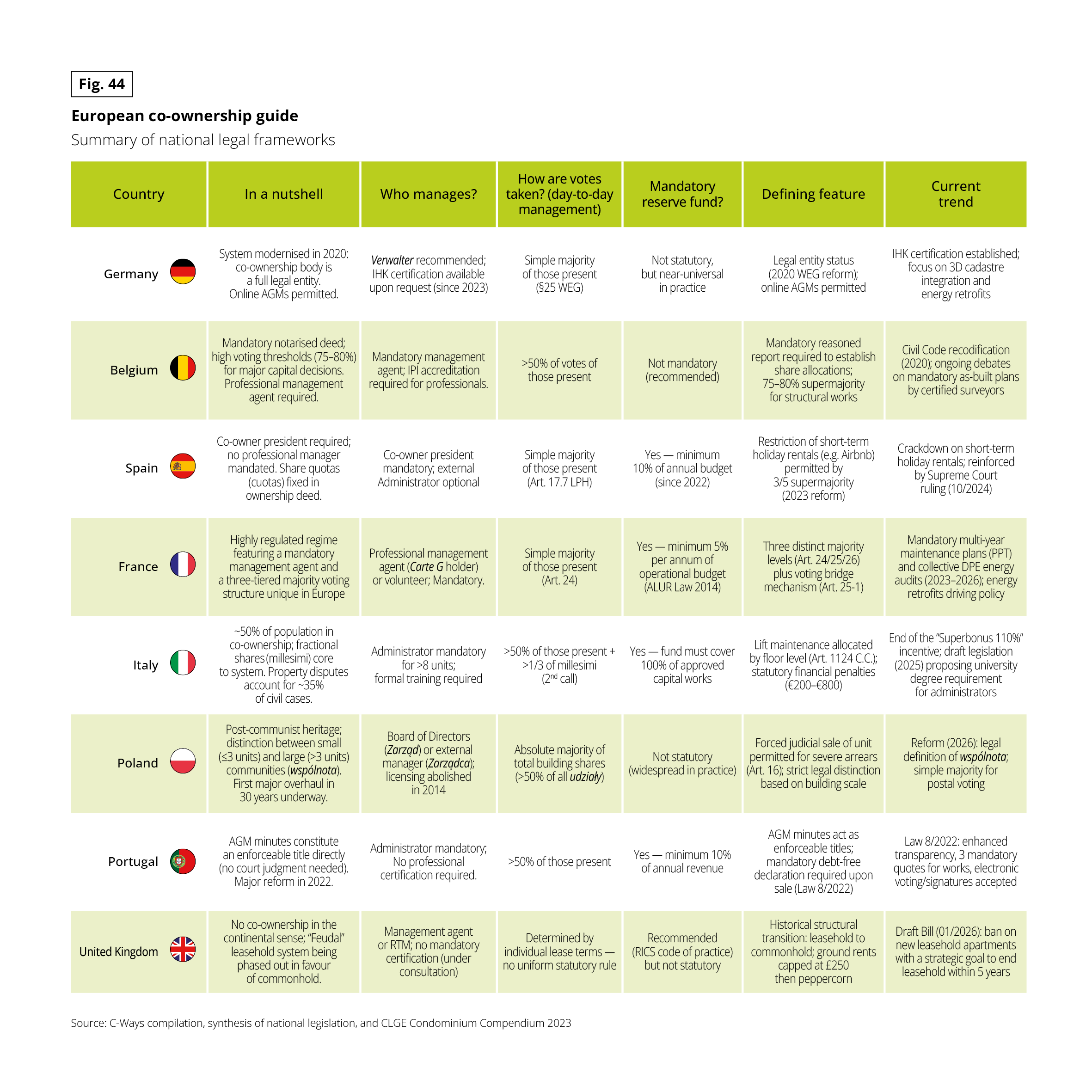 Table with eight rows (one per country) and six columns: in a nutshell, who manages, how votes are taken (day-to-day management), mandatory reserve fund, defining feature, and current trend. Source: C-Ways compilation, synthesis of national legislation, and CLGE Condominium Compendium 2023.
Germany
• In a nutshell: system modernised in 2020; the co-ownership body is a full legal entity; online general meetings permitted.
• Who manages: a Verwalter is recommended; IHK certification available upon request (since 2023).
• Votes: simple majority of those present (§25 WEG).
• Reserve fund: not statutory, but near-universal in practice.
• Defining feature: legal entity status (2020 WEG reform); online meetings permitted.
• Current trend: IHK certification established; focus on 3D cadastre integration and energy retrofits.
Belgium
• In a nutshell: mandatory notarised deed; high voting thresholds (75–80%) for major capital decisions; professional management agent required.
• Who manages: mandatory management agent; IPI accreditation required for professionals.
• Votes: more than 50% of votes of those present.
• Reserve fund: not mandatory (recommended).
• Defining feature: mandatory reasoned report required to establish share allocations; 75–80% supermajority for structural works.
• Current trend: Civil Code recodification (2020); ongoing debates on mandatory as-built plans by certified surveyors.
Spain
• In a nutshell: co-owner president required; no professional manager mandated; share quotas (cuotas) fixed in the ownership deed.
• Who manages: co-owner president mandatory; external administrator optional.
• Votes: simple majority of those present (Art. 17.7 LPH).
• Reserve fund: yes, minimum 10% of annual budget (since 2022).
• Defining feature: restriction of short-term holiday rentals (e.g. Airbnb) permitted by a 3/5 supermajority (2023 reform).
• Current trend: crackdown on short-term holiday rentals, reinforced by a Supreme Court ruling (10/2024).
France
• In a nutshell: highly regulated regime with a mandatory management agent and a three-tiered majority voting structure unique in Europe.
• Who manages: professional management agent (Carte G holder) or volunteer; mandatory.
• Votes: simple majority of those present (Art. 24).
• Reserve fund: yes, minimum 5% per annum of operational budget (ALUR Law 2014).
• Defining feature: three distinct majority levels (Art. 24/25/26) plus a voting bridge mechanism (Art. 25-1).
• Current trend: mandatory multi-year maintenance plans (PPT) and collective DPE energy audits (2023–2026); energy retrofits driving policy.
Italy
• In a nutshell: about 50% of the population in co-ownership; fractional shares (millesimi) are core to the system; property disputes account for about 35% of civil cases.
• Who manages: administrator mandatory for more than 8 units; formal training required.
• Votes: more than 50% of those present plus more than 1/3 of the millesimi (second call).
• Reserve fund: yes, the fund must cover 100% of approved capital works.
• Defining feature: lift maintenance allocated by floor level (Art. 1124 C.C.); statutory financial penalties (€200–€800).
• Current trend: end of the “Superbonus 110%” incentive; draft legislation (2025) proposing a university degree requirement for administrators.
Poland
• In a nutshell: post-communist heritage; distinction between small (3 units or fewer) and large (more than 3 units) communities (wspólnota); first major overhaul in 30 years underway.
• Who manages: Board of Directors (Zarząd) or external manager (Zarządca); licensing abolished in 2014.
• Votes: absolute majority of total building shares (more than 50% of all udziały).
• Reserve fund: not statutory (widespread in practice).
• Defining feature: forced judicial sale of a unit permitted for severe arrears (Art. 16); strict legal distinction based on building scale.
• Current trend: reform (2026): legal definition of wspólnota; simple majority for postal voting.
Portugal
• In a nutshell: general meeting minutes constitute an enforceable title directly (no court judgment needed); major reform in 2022.
• Who manages: administrator mandatory; no professional certification required.
• Votes: more than 50% of those present.
• Reserve fund: yes, minimum 10% of annual revenue.
• Defining feature: general meeting minutes act as enforceable titles; mandatory debt-free declaration required upon sale (Law 8/2022).
• Current trend: Law 8/2022: enhanced transparency, 3 mandatory quotes for works, electronic voting/signatures accepted.
United Kingdom
• In a nutshell: no co-ownership in the continental sense; the “feudal” leasehold system is being phased out in favour of commonhold.
• Who manages: management agent or RTM; no mandatory certification (under consultation).
• Votes: determined by individual lease terms; no uniform statutory rule.
• Reserve fund: recommended (RICS code of practice) but not statutory.
• Defining feature: historical structural transition: leasehold to commonhold; ground rents capped at £250, then peppercorn.
• Current trend: Draft Bill (01/2026): ban on new leasehold apartments, with a strategic goal to end leasehold within 5 years.
Spain, France, Italy and Portugal require a reserve fund. Germany and Poland have none by statute but use one in practice.
MANAGEMENT AGENTS PROVIDE REASSURANCE, BUT DIVIDE OPINION AMONG CO-OWNERS
Management, whether structured as a management agent or administrator, inspires genuine if measured satisfaction. On a scale of 0 to 10, European co-owners award their management agents an average score of 6.9. Roughly half express clear satisfaction, assigning scores between 8 and 10. Conversely, a 12% minority proves resolutely critical, rating their manager below 5. The management agent thus inspires cautious approval rather than unreserved endorsement. The analysis of the focus countries confirms the hierarchy observed earlier. Portugal, Spain and Belgium register the highest satisfaction levels, with approximately 55% of co-owners awarding top marks. They are followed by a more reserved France at 47% and a distinctly more critical Italy at just 41%.
This final figure completes the Italian profile: a country where co owners are highly engaged yet hold their property management in low regard, a hallmark of a more contentious relationship with collective governance. Satisfaction with the property management thus serves as an accurate reflection of the overall climate within a co-ownership. These cross-national disparities closely align with differing legal models. Spain achieves the highest satisfaction despite requiring no professional management agent. Belgium, which mandates an accredited agent, follows closely behind, demonstrating that a strict regulatory framework can reassure residents without necessarily generating enthusiasm. Conversely, Italy brings up the rear despite mandating a trained administrator, in a country where co-ownership disputes reportedly account for nearly one third of civil litigation. The presence of a professional manager is therefore not enough to restore harmony: the prevailing decision-making culture matters every bit as much as the legal framework.
Fig. 45 – Satisfaction with the management agent or administrator
Download this infographic for your presentations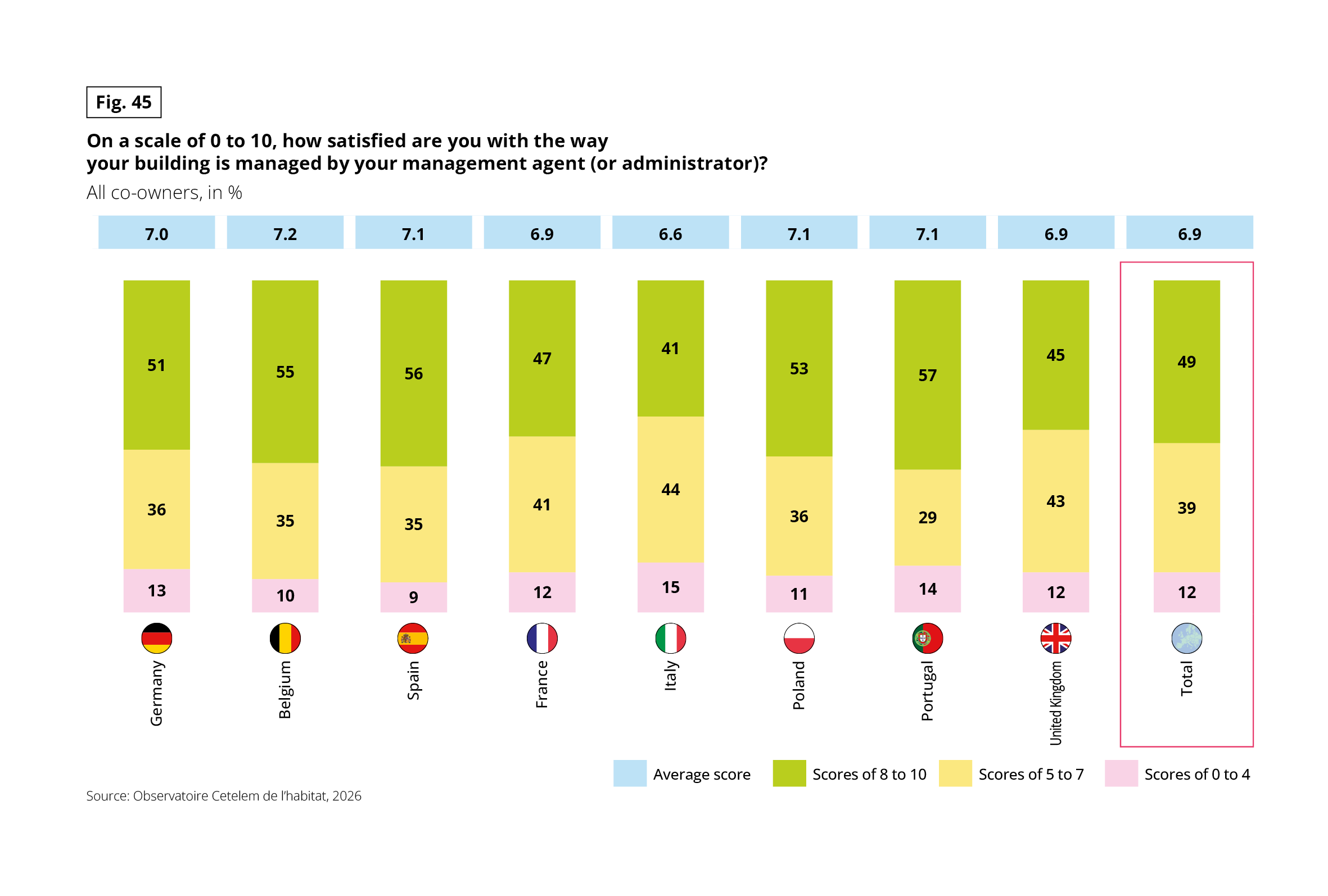 Stacked vertical bar chart. Question: “On a scale of 0 to 10, how satisfied are you with the way your building is managed by your management agent (or administrator)?” Base: all co-owners, in %. Scores are grouped into 8 to 10, 5 to 7 and 0 to 4. The average score is shown above each column. Source: Observatoire Cetelem de l’habitat, 2026.
Data in the form scores 8–10 / 5–7 / 0–4 (average score):
• Germany: 51 / 36 / 13 (7.0)
• Belgium: 55 / 35 / 10 (7.2)
• Spain: 56 / 35 / 9 (7.1)
• France: 47 / 41 / 12 (6.9)
• Italy: 41 / 44 / 15 (6.6)
• Poland: 53 / 36 / 11 (7.1)
• Portugal: 57 / 29 / 14 (7.1)
• United Kingdom: 45 / 43 / 12 (6.9)
• Total: 49 / 39 / 12 (6.9)
Satisfaction is highest in Belgium (7.2). Italy has the lowest average (6.6) and the lowest share of high scores (41%). Portugal has the highest share of high scores (57%).
DECISIONS GET MADE, WITH A SLIGHT STUMBLE ON EXECUTION
The ultimate test remains: the quality of the decision-making process itself. When asked how choices are made—whether regarding building works, maintenance, service providers or financing—co-owners view the mechanism as broadly consensus-driven (79%) and well suited to handling urgent matters (78%). Conversely, slightly fewer consider it effective, at 75%.
All three dimensions are neck-and-neck, pointing to an operational model that is generally well received. Yet the minor lag in effectiveness is revealing: residents reach agreement and react promptly, without always feeling confident that decisions will translate into action. Execution is the weakest link in the chain.
Italy provides a prime example of this paradox. Its co-owners are among the most likely to view their decisions as consensus-driven (82%), yet among the least likely to deem them effective (just 70%).
Residents there reach an agreement, but without always achieving results. Belgium presents the opposite picture: solid perceived effectiveness (78%), but the lowest consensus and responsiveness scores among the four focus countries (73% for each).
Spain registers high marks across the board, reaching 82% on consensus and 80% on emergency responsiveness, while France displays the most balanced profile, hovering between 76% and 78% across all three metrics. Each country thus exhibits its own specific vulnerability, but everywhere it is the ability to turn agreement into concrete action that remains the most uncertain, even if scores stay comfortably in majority territory (averaging 75%). Legal frameworks help explain these profiles: the high supermajorities required in Belgium for major decisions safeguard consensus but slow response times, whereas in Italy the weight of fractional ownership shares and frequent litigation hamper execution effectiveness.
Fig. 46 – Co-ownership decision-making: consensus, urgency and effectiveness
Download this infographic for your presentations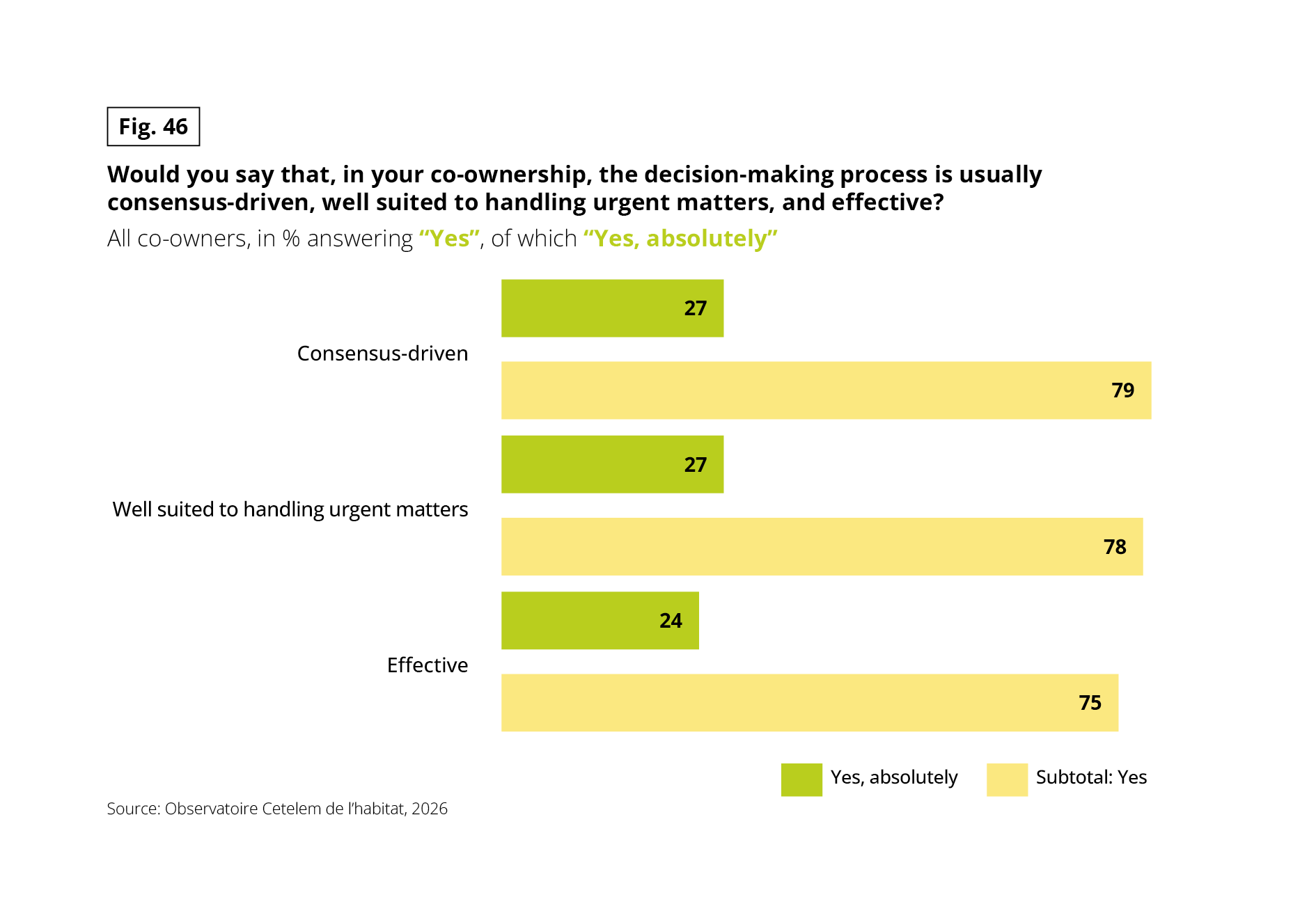 Horizontal bar chart. Question: “Would you say that, in your co-ownership, the decision-making process is usually consensus-driven, well suited to handling urgent matters, and effective?” Base: all co-owners, in %. Two figures per item: “Yes, absolutely” and the subtotal “Yes”. Source: Observatoire Cetelem de l’habitat, 2026.
Data in the form yes, absolutely / subtotal yes:
• Consensus-driven: 27 / 79
• Well suited to handling urgent matters: 27 / 78
• Effective: 24 / 75
Co-owners are slightly less positive about effectiveness than about consensus.
KEY FIGURES
- 76% of Europeans are comfortable with collective decision-making, while 37% actively see a benefit in shared governance
- 65 % consider it preferable for every resident to have a say regarding energy choices for their building or neighbourhood
- 75 % of co-owners consider their property to be well managed, and 78% feel that their views are taken into account
- 6.9/10 average score awarded to management agents, with Italy expressing the most critical outlook (41% assigning scores of 8–10)
- The decision-making process is widely viewed as consensus-driven (79%) and well suited to handling urgent matters (78%), though slightly less so on effectiveness (75%)
- Italy stands out: the highest levels of resident engagement (72–73%) and consensus (82%), yet trailing on management satisfaction (68%) and execution effectiveness (70%)