
Proximity as a decisive factor


 2 min
reading time
2 min
reading time
Is the duel between price and nationality destined to produce the exact same winner every time? Evidently so: drivers, as consumers facing constant financial constraints, will always point their compass toward price when choosing a car. Yet, as in many sectors where global reach and local presence harmoniously coexist, cross-border brands with strong domestic roots possess other assets to enhance their customer appeal. This edition of the Observatoire Cetelem underscores the pivotal role of dealer networks, especially local dealerships, alongside innovation, spearheaded by electric powertrains and artificial intelligence.
DIRECT CUSTOMER CONTACT
We highlighted earlier that, in the eyes of motorists, a brand’s identity hinges more on where its cars are born and built than on the origin of its corporate capital. The weight given to this local dimension and expected proximity is reinforced by a closely aligned factor. While price remains paramount for drivers, dealership networks and after-sales service rank as the second most critical brand consideration. It offers brands a tangible presence in their markets, both at home and across international borders, by maintaining direct contact with their customer base. Indeed, 3 in 4 drivers value this human reassurance. Demand for such local proximity is highest in China, Turkey, Italy and Portugal. Older consumers and higher-income earners also show a strong preference for a local footprint.
Fig. 42 – Importance of criteria regarding a car brand (% “important”)
Download this infographic for your presentations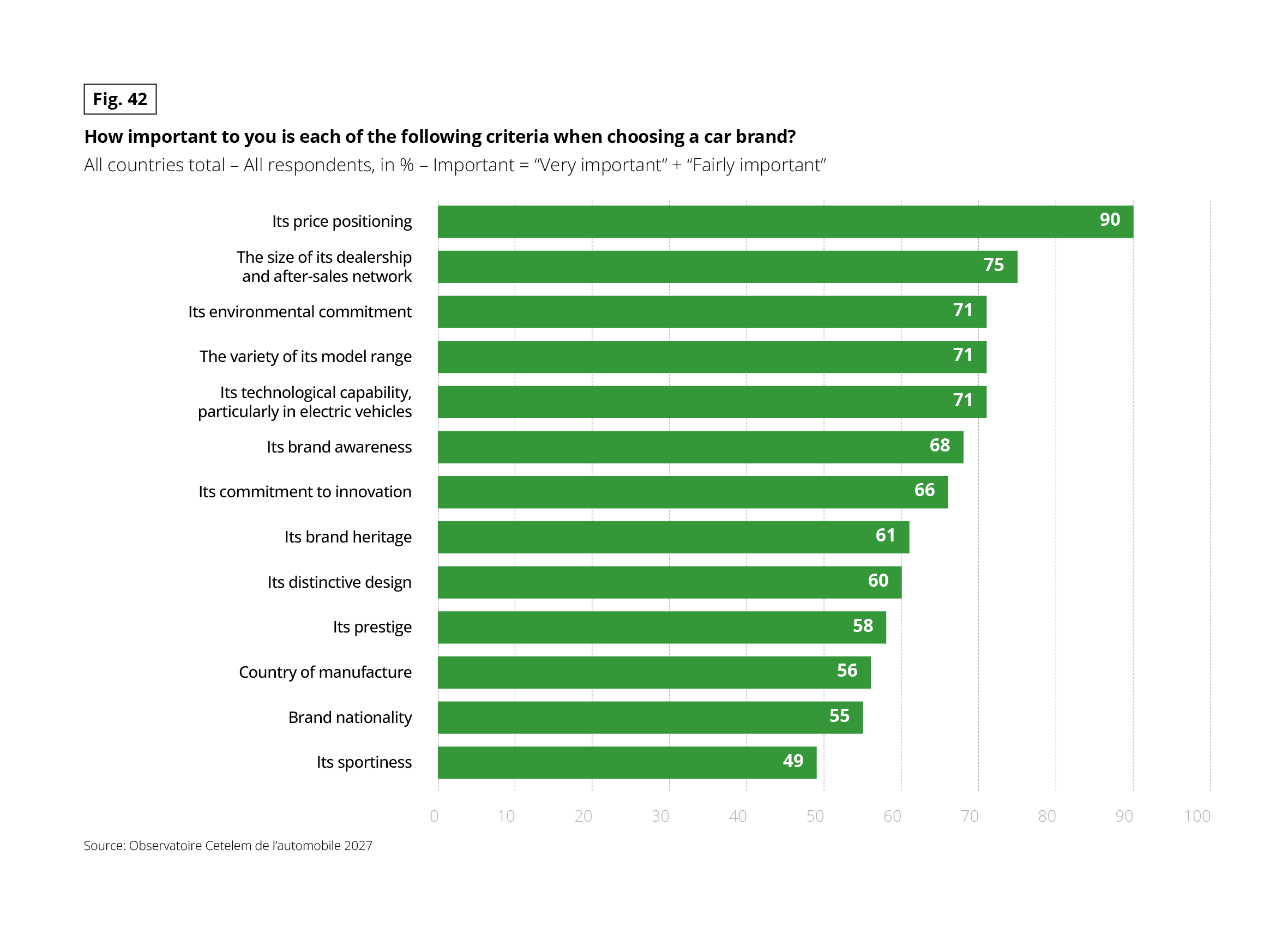 Horizontal bar chart. Question: “How important to you is each of the following criteria when choosing a car brand?” Base: all countries total, all respondents, in %. “Important” groups “Very important” and “Fairly important”. Source: Observatoire Cetelem de l’automobile 2027.
Criteria, from most to least important:
1. Its price positioning: 90%
2. The size of its dealership and after-sales network: 75%
3. Its environmental commitment: 71%
4. The variety of its model range: 71%
5. Its technological capability, particularly in electric vehicles: 71%
6. Its brand awareness: 68%
7. Its commitment to innovation: 66%
8. Its brand heritage: 61%
9. Its distinctive design: 60%
10.Its prestige: 58%
11.Country of manufacture: 56%
12.Brand nationality: 55%
13.Its sportiness: 49%
Price positioning is by far the most important criterion. Every criterion is considered important by about half of respondents or more. Brand nationality (55%) and country of manufacture (56%) rank in the lower part of the list.
Horizontal bar chart. Question: “How important to you is each of the following criteria when choosing a car brand?” Base: all countries total, all respondents, in %. “Important” groups “Very important” and “Fairly important”. Source: Observatoire Cetelem de l’automobile 2027.
Criteria, from most to least important:
1. Its price positioning: 90%
2. The size of its dealership and after-sales network: 75%
3. Its environmental commitment: 71%
4. The variety of its model range: 71%
5. Its technological capability, particularly in electric vehicles: 71%
6. Its brand awareness: 68%
7. Its commitment to innovation: 66%
8. Its brand heritage: 61%
9. Its distinctive design: 60%
10.Its prestige: 58%
11.Country of manufacture: 56%
12.Brand nationality: 55%
13.Its sportiness: 49%
Price positioning is by far the most important criterion. Every criterion is considered important by about half of respondents or more. Brand nationality (55%) and country of manufacture (56%) rank in the lower part of the list.
THE PIVOTAL ROLE OF THE DEALERSHIP
The demand for human reassurance makes local proximity a key asset, with dealerships playing the starring role. Nearly 7 in 10 motorists confirm the dealer influences their choice of brand, a figure that jumps for new-car buyers (+17% compared to second-hand purchases). Chinese, Japanese, Spanish and Portuguese drivers place the highest trust in dealerships, in contrast to Dutch motorists, the only group where a majority downplays dealer influence. Likely reflecting their relative lack of automotive experience, younger buyers are the most receptive to dealership advice.
Fig. 43 – Dealer influence on vehicle brand choice (% “important”, equipped households)
Download this infographic for your presentations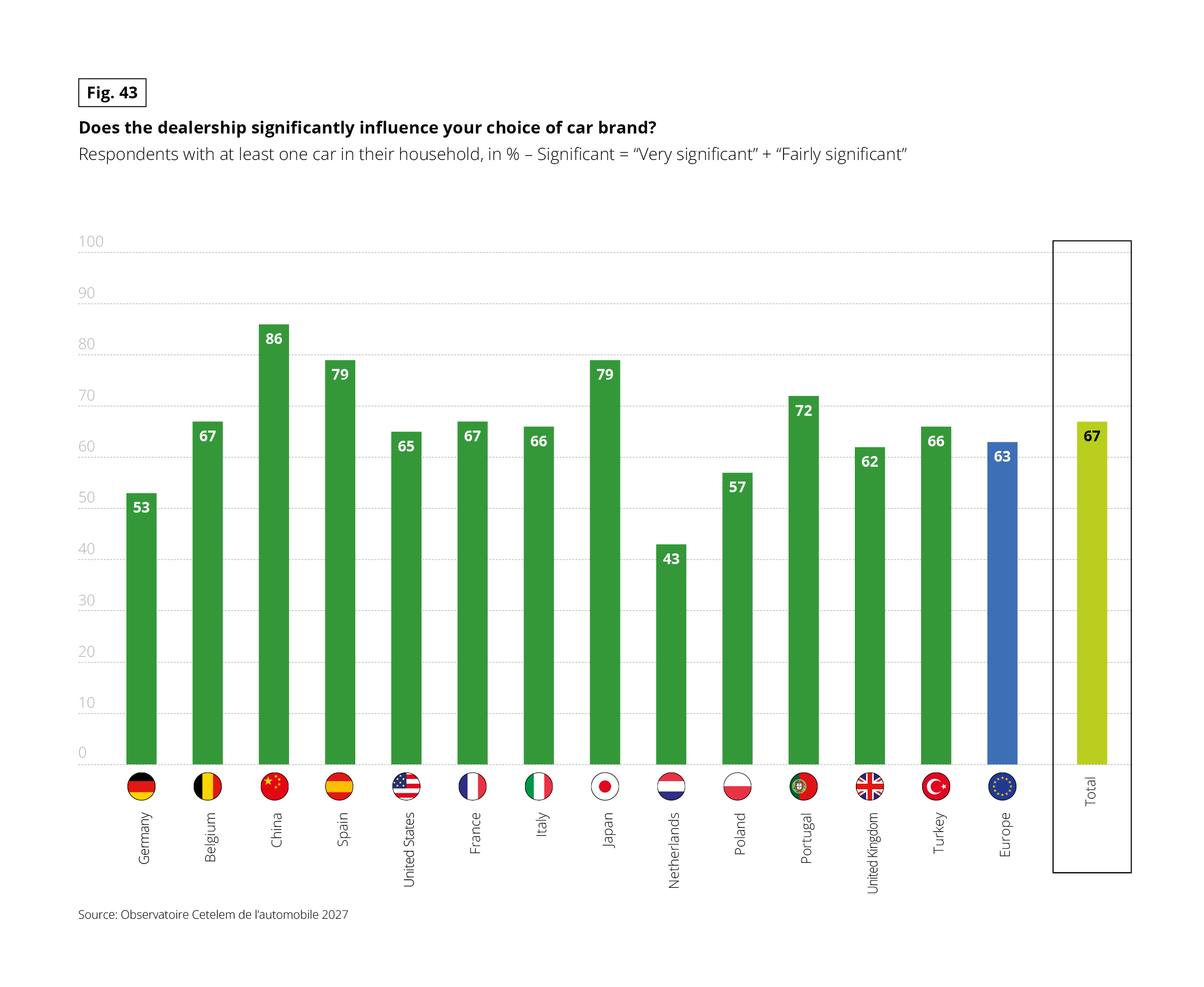 Vertical bar chart. Question: “Does the dealership significantly influence your choice of car brand?” Base: respondents with at least one car in their household, in %. “Significant” groups “Very significant” and “Fairly significant”. Source: Observatoire Cetelem de l’automobile 2027. Across all countries combined, 67% say the dealership has a significant influence. China is the highest (86%) and the Netherlands the lowest (43%).
Data by country: Germany 53%, Belgium 67%, China 86%, Spain 79%, United States 65%, France 67%, Italy 66%, Japan 79%, Netherlands 43%, Poland 57%, Portugal 72%, United Kingdom 62%, Turkey 66%. The European average is 63%. The total is 67%.
Vertical bar chart. Question: “Does the dealership significantly influence your choice of car brand?” Base: respondents with at least one car in their household, in %. “Significant” groups “Very significant” and “Fairly significant”. Source: Observatoire Cetelem de l’automobile 2027. Across all countries combined, 67% say the dealership has a significant influence. China is the highest (86%) and the Netherlands the lowest (43%).
Data by country: Germany 53%, Belgium 67%, China 86%, Spain 79%, United States 65%, France 67%, Italy 66%, Japan 79%, Netherlands 43%, Poland 57%, Portugal 72%, United Kingdom 62%, Turkey 66%. The European average is 63%. The total is 67%.