
Above all, good health!


 4 min
reading time
4 min
reading time
With the Covid-19 health crisis, societal issues have begun to focus on the topic of health, particularly for senior citizens. In the post-pandemic era, its importance is more relevant than ever. As time goes by and life takes its course, health is the number one concern of senior citizens, as this edition of the Observatoire Cetelem shows. However, it cannot be reduced to the healthcare services required to preserve it. It’s important to be in good health, of course, but above all to enjoy life, preferably at home, in complete independence.
A MULTI-GENERATIONAL CONCERN
As we have just seen, the future of the healthcare system is a major issue in European societies. Over and above political, financial and organisational concerns, health is by far the number one concern for Europeans of all ages. 8 out of 10 agreed that “ageing well in good health” should be their priority.
This score has risen slightly since 2016. Quite logically, senior citizens rallied en masse around this aim (91%), with younger people thinking about it less, but still thinking about it a lot.
From one country to another, the level of support for this opinion was more or less comparable. This priority was highest in France and Italy, and lowest in Poland (83% and 85% vs. 67%).
Fig 12 – Definition of successful aging by age
Download this infographic for your presentations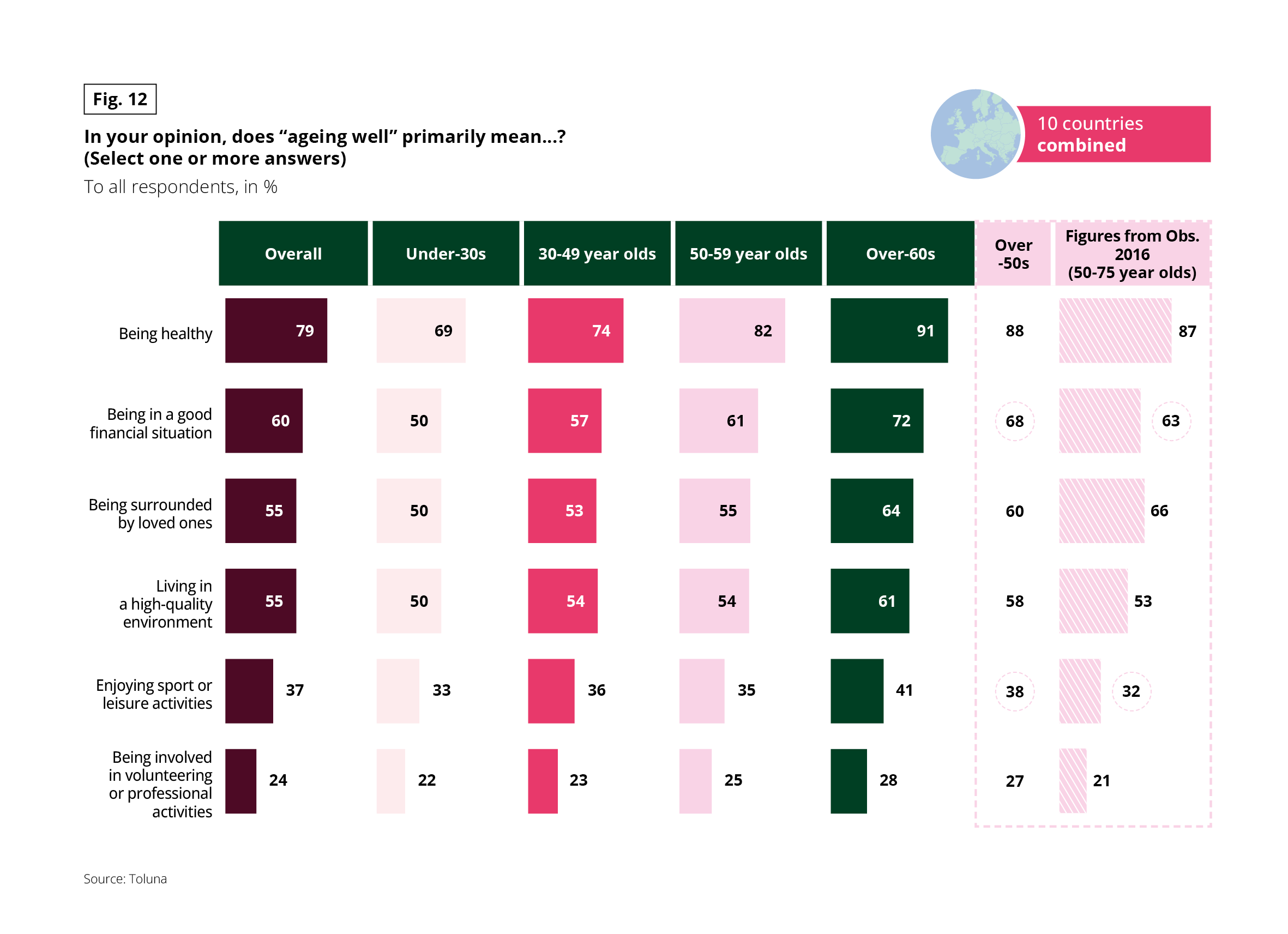 The table presents the criteria associated with “successful aging”, with comparisons by age group.
Data (all)
Being in good health: 79%
Having a good financial situation: 60%
Being surrounded by loved ones: 55%
Having a quality environment: 55%
Having sports or leisure activities: 37%
Having associative or professional activities: 24%
Main Finding Health is by far the most cited criterion for successful aging, with increasing importance among those 60 years and older.
The table presents the criteria associated with “successful aging”, with comparisons by age group.
Data (all)
Being in good health: 79%
Having a good financial situation: 60%
Being surrounded by loved ones: 55%
Having a quality environment: 55%
Having sports or leisure activities: 37%
Having associative or professional activities: 24%
Main Finding Health is by far the most cited criterion for successful aging, with increasing importance among those 60 years and older.
LIVING IN GOOD HEALTH: GREAT EXPECTATIONS
If we agree that the average retirement age is around 65, then the importance of good health in the future is all the greater. Seniors will have plenty of time ahead of them, but they need it to be peaceful and carefree. Healthy life expectancy shows that in the next ten years or so, there is no reason for them to give into intense hypochondria. They will be able to fully play their social and economic role, which is becoming increasingly important in European countries.
Two points are worth highlighting.
The Covid-19 health crisis has put an end, albeit temporarily, to this mechanism, leading to a lower healthy life expectancy than that observed ten years ago. The economic strength of each country, and therefore the standard of living of its inhabitants, also has a very positive influence on this parameter.
Social organisation also plays a central role, as confirmed by the higher healthy life expectancy of Swedes.
Fig 13 – Healthy life expectancy at 65
Download this infographic for your presentations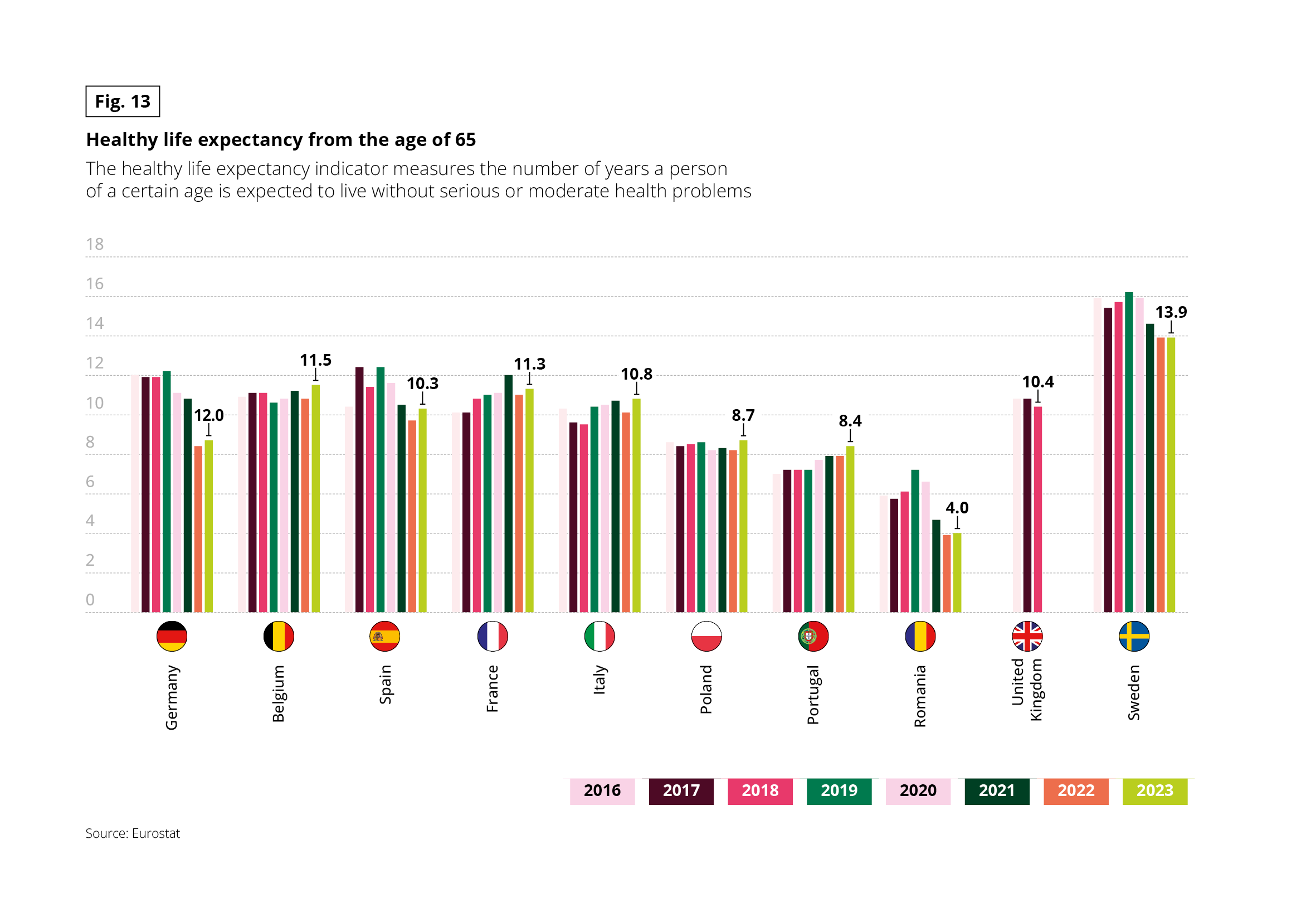 The graph measures the number of years a 65-year-old person can expect to live without severe or moderate health limitations.
Data (2023 values): Germany: 12.0 years Belgium: 11.5 years Spain: 10.3 years France: 11.3 years Italy: 10.8 years Poland: 8.7 years Portugal: 8.4 years Romania: 4.0 years United Kingdom: 10.4 years Sweden: 13.9 years
Main finding: There are significant differences between countries, with a higher healthy life expectancy in Northern Europe than in Eastern Europe.
Source: Eurostat
The graph measures the number of years a 65-year-old person can expect to live without severe or moderate health limitations.
Data (2023 values): Germany: 12.0 years Belgium: 11.5 years Spain: 10.3 years France: 11.3 years Italy: 10.8 years Poland: 8.7 years Portugal: 8.4 years Romania: 4.0 years United Kingdom: 10.4 years Sweden: 13.9 years
Main finding: There are significant differences between countries, with a higher healthy life expectancy in Northern Europe than in Eastern Europe.
Source: Eurostat
DOING MORE
To meet the challenges linked to an ever-increasing senior population, the healthcare system is a key concern. Of all the measures that need to be implemented as a matter of priority, reinforcing the healthcare system came out on top with 38% of the vote.
This was of course the primary objective of senior citizens, but also that of the under-60s (48% and 35%).
This measure was emphasized in all countries, with the exception of Germany, where adapting the pension funding system was assigned greater importance, as this is a priority in the face of one of the fastest ageing populations in Europe.
Fig 14 – Priority actions to address demographic aging
Download this infographic for your presentations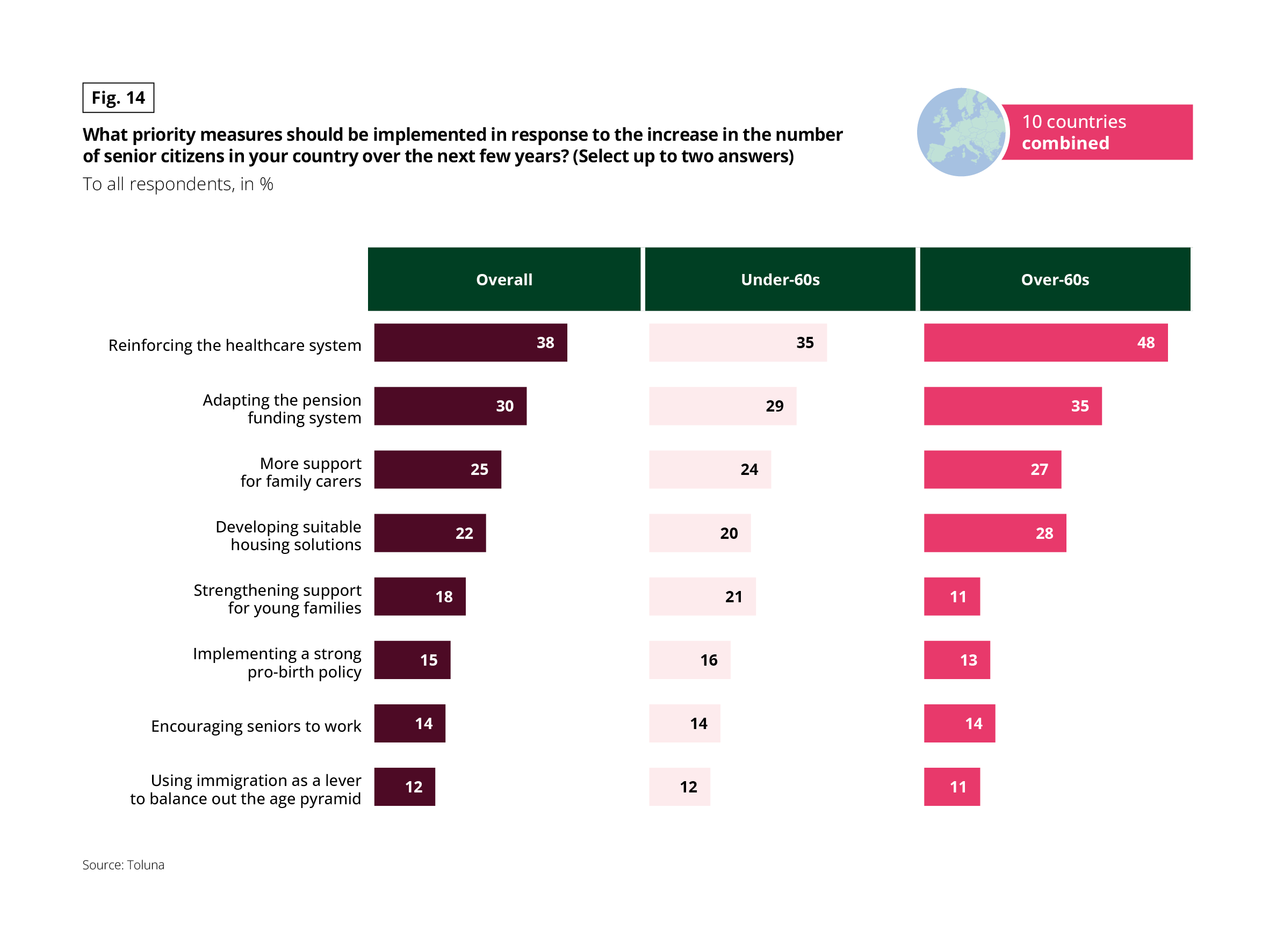 The table summarizes the actions considered priority to address population aging, with a comparison by age.
Data (overall): Strengthen the healthcare system: 38% Adapt retirement financing: 30% Support family caregivers more: 25% Develop adapted housing: 22% Strengthen support for young families: 18% Pro-natal policy: 15% Encourage senior work: 14% Immigration as a demographic lever: 12%
Main finding: Strengthening the healthcare system appears as the most frequently cited priority, especially among those 60 and over.
The table summarizes the actions considered priority to address population aging, with a comparison by age.
Data (overall): Strengthen the healthcare system: 38% Adapt retirement financing: 30% Support family caregivers more: 25% Develop adapted housing: 22% Strengthen support for young families: 18% Pro-natal policy: 15% Encourage senior work: 14% Immigration as a demographic lever: 12%
Main finding: Strengthening the healthcare system appears as the most frequently cited priority, especially among those 60 and over.
THE FINANCIAL BURDEN OF HEALTHCARE
Fig 15 – Current health expenditures by country
Download this infographic for your presentations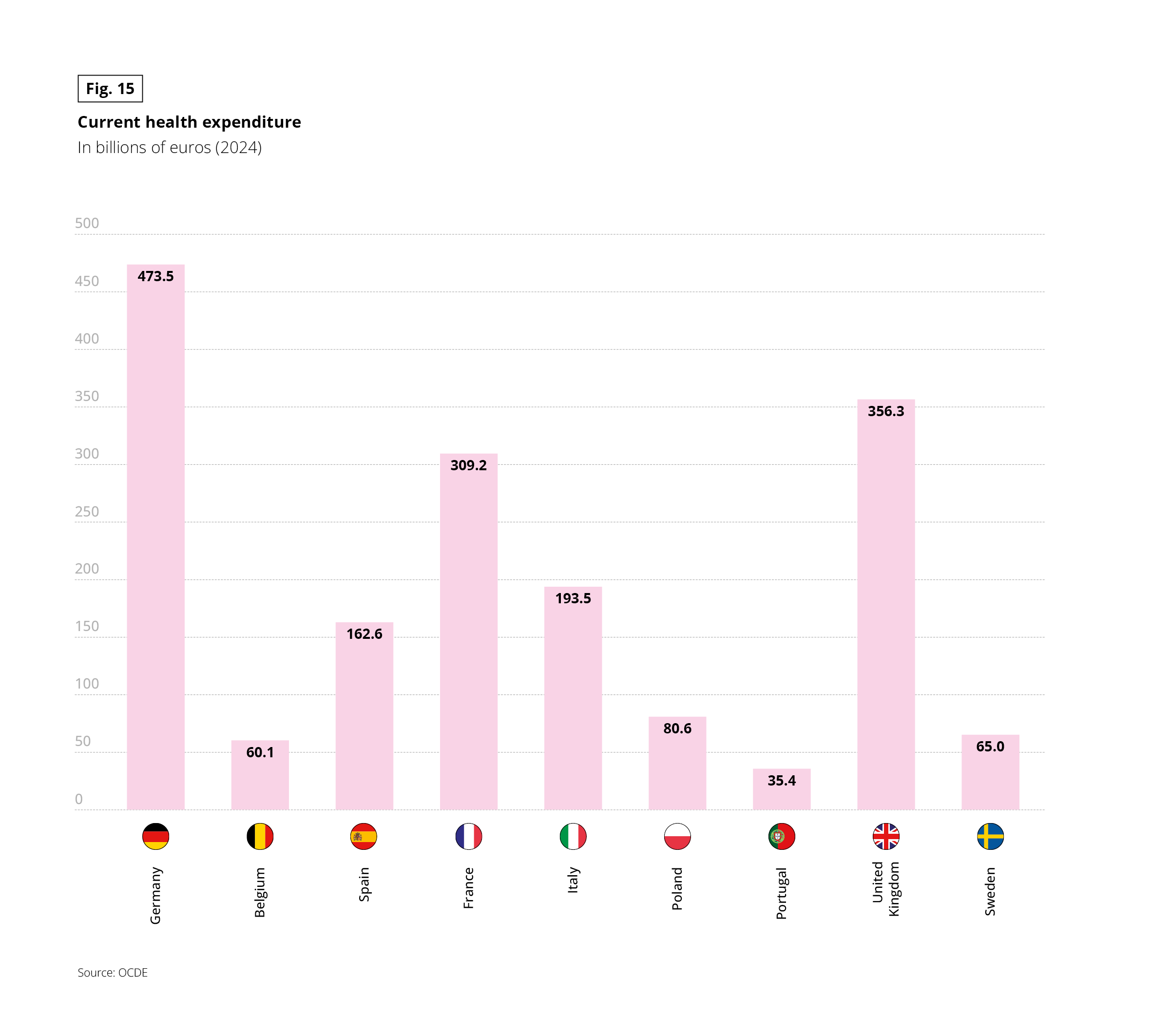 The graph presents the total amount of current health expenditures for 2024.
Data: Germany: 473.5 France: 309.2 United Kingdom: 356.3 Italy: 193.5 Spain: 162.6 Poland: 80.6 Sweden: 65.0 Belgium: 60.1 Portugal: 35.4
Main finding: Health expenditures vary greatly depending on the demographic and economic size of the countries, with particularly high amounts in Germany, the United Kingdom, and France.
Source: OECD
The graph presents the total amount of current health expenditures for 2024.
Data: Germany: 473.5 France: 309.2 United Kingdom: 356.3 Italy: 193.5 Spain: 162.6 Poland: 80.6 Sweden: 65.0 Belgium: 60.1 Portugal: 35.4
Main finding: Health expenditures vary greatly depending on the demographic and economic size of the countries, with particularly high amounts in Germany, the United Kingdom, and France.
Source: OECD
Fig 16 – Health expenditures as a share of GDP
Download this infographic for your presentations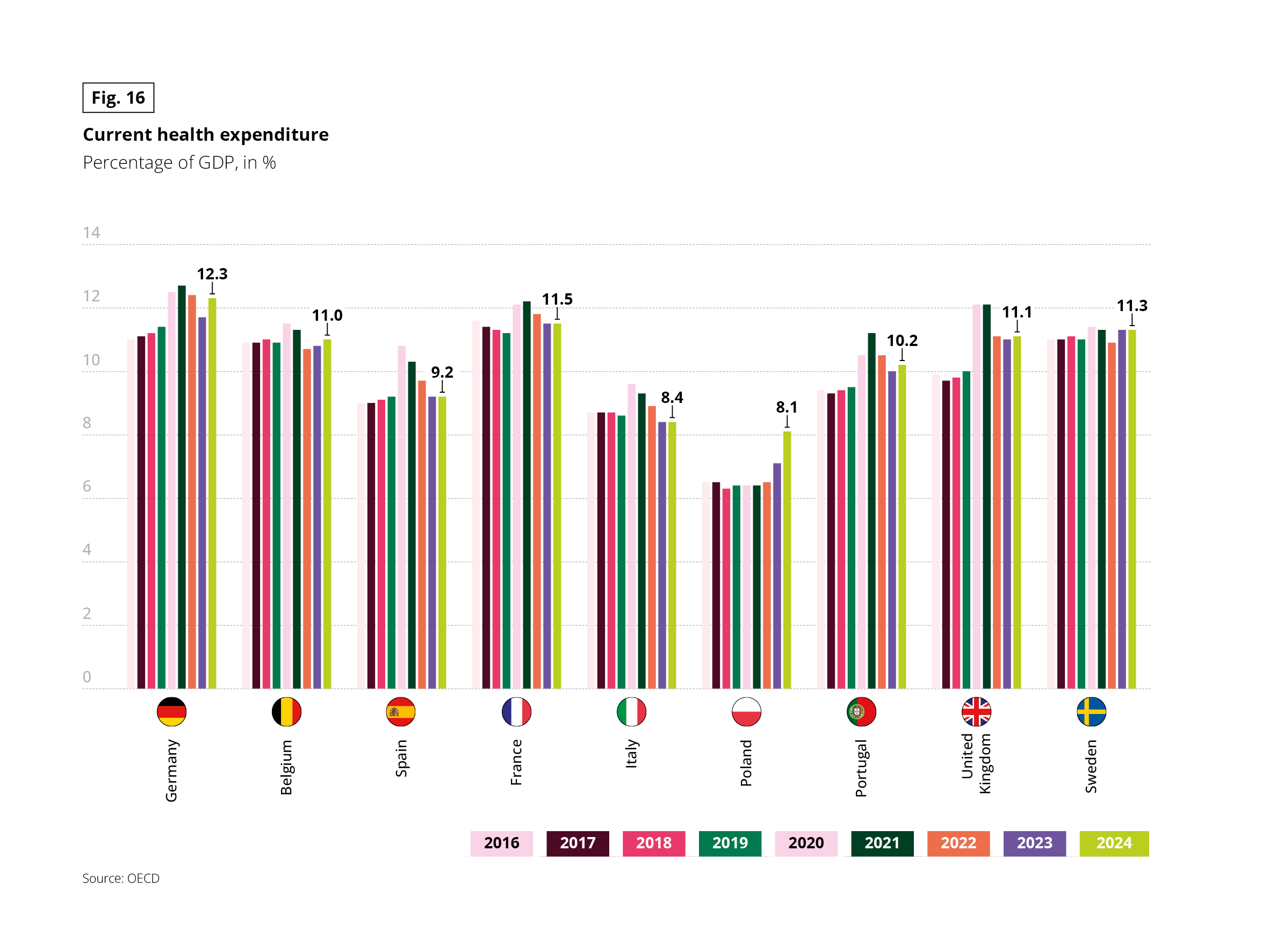 The graph shows the evolution of the share of GDP devoted to health expenditures between 2016 and 2024.
Data (2024 values): Germany: 12.3% France: 11.5% United Kingdom: 11.1% Sweden: 11.3% Belgium: 11.0% Spain: 9.2% Italy: 8.4% Portugal: 10.2% Poland: 8.1%
Main finding: The share of GDP devoted to health is higher in Northern and Western Europe than in Southern and Eastern Europe.
Source: OECD
The graph shows the evolution of the share of GDP devoted to health expenditures between 2016 and 2024.
Data (2024 values): Germany: 12.3% France: 11.5% United Kingdom: 11.1% Sweden: 11.3% Belgium: 11.0% Spain: 9.2% Italy: 8.4% Portugal: 10.2% Poland: 8.1%
Main finding: The share of GDP devoted to health is higher in Northern and Western Europe than in Southern and Eastern Europe.
Source: OECD
Leaving aside the Covid-19 health crisis, which naturally represented a peak in healthcare spending, this expenditure has been rising steadily over the last 10 years in most European countries.
In France, in 2024, it represented 11.5% of GDP, compared with 10% on average in Europe. Italy is one of the few countries where it is falling, with millions of Italians having given up on healthcare because of economic problems, regional differences in terms of healthcare provision and excessive waiting times. At the same time, spending related to wellbeing* represented between 8% and 10% of GDP in France, compared with around 9% in Europe (source: Global Wellness Economy Monitor 2025).
* Wellbeing real estate, mental wellbeing, physical activity, personal care and beauty, healthy eating, nutrition and weight loss, traditional and complementary medicine, wellness tourism, spas, thermal and mineral springs, public health, prevention and personalised medicine, wellbeing at work
A DIGITISED APPROACH TO SELF-CARE
Health is a key issue for the future, and the use of new technologies (telemedicine, AI, predictive medicine, etc.) will be an asset. Seniors are emphasising this by paying close attention to this technology, which will enable them to age better at home, for as long as possible.
4 out of 10 use them or are ready to use them in the near future. Romanians and Poles are particularly determined to go digital (77% and 72%). The Belgians and the French are more circumspect (32% and 33%). Might this difference be due to the relative size and efficiency of the healthcare system in these four countries?
Fig 17 – Use of digital health technologies by seniors
Download this infographic for your presentations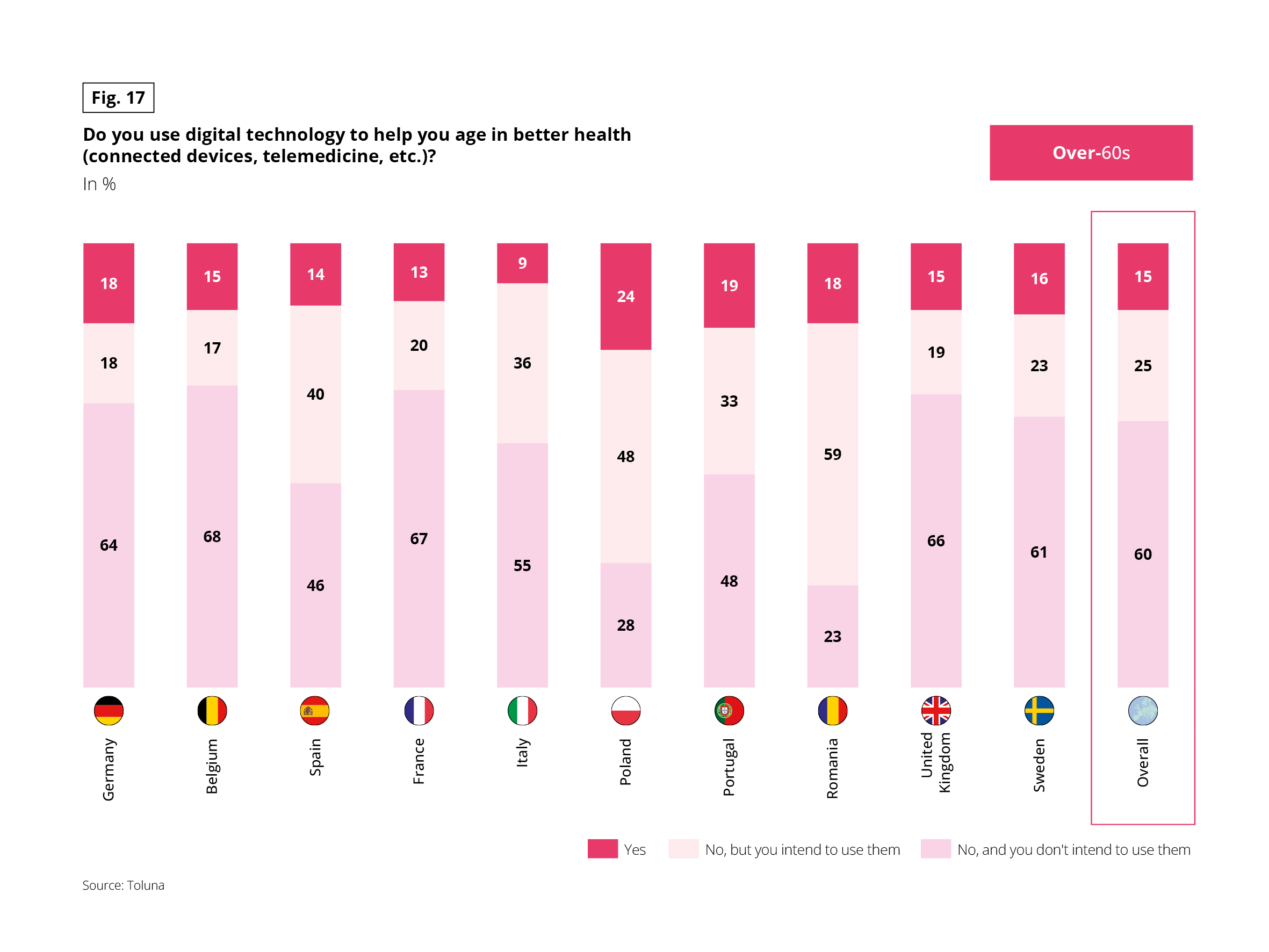 The graph presents the share of people 60 and over using or intending to use digital health technologies to age healthier.
Data (total): Using: 15% Not using but intending to: 25% Not using and not intending to: 60%
Country benchmarks (using): Germany: 18% France: 13% Italy: 9% Poland: 24% Sweden: 16%
Main finding: In all countries, a majority of seniors do not use digital health technologies, although a significant share expresses a future intention to do so.
Source: Toluna
The graph presents the share of people 60 and over using or intending to use digital health technologies to age healthier.
Data (total): Using: 15% Not using but intending to: 25% Not using and not intending to: 60%
Country benchmarks (using): Germany: 18% France: 13% Italy: 9% Poland: 24% Sweden: 16%
Main finding: In all countries, a majority of seniors do not use digital health technologies, although a significant share expresses a future intention to do so.
Source: Toluna