Living well for yourself and others

 3 min
reading time
3 min
reading time
TREAT YOURSELF, BUT NOT AT ANY PRICE
Could it be that senior citizens are epicureans without realising it? You’d be tempted to think so, since what they want, above all, is to treat themselves and enjoy the comfort they feel they need, without indulging this twofold objective through unnecessary spending. In other words, this fits with the reasonable satisfaction of pleasure advocated by the Samos philosopher.
There are significant generational differences in these three areas. 91% of seniors wanted to treat themselves from time to time. Among the under-60s, 83% agreed. 88% of seniors said yes to comfort. 81% of the under-60s agreed. When it comes to unnecessary spending, the gap between the two generations rose to 11 points, with 8 out of 10 seniors ruling it out.
Fig 20 – Perceptions of consumption by age
Download this infographic for your presentations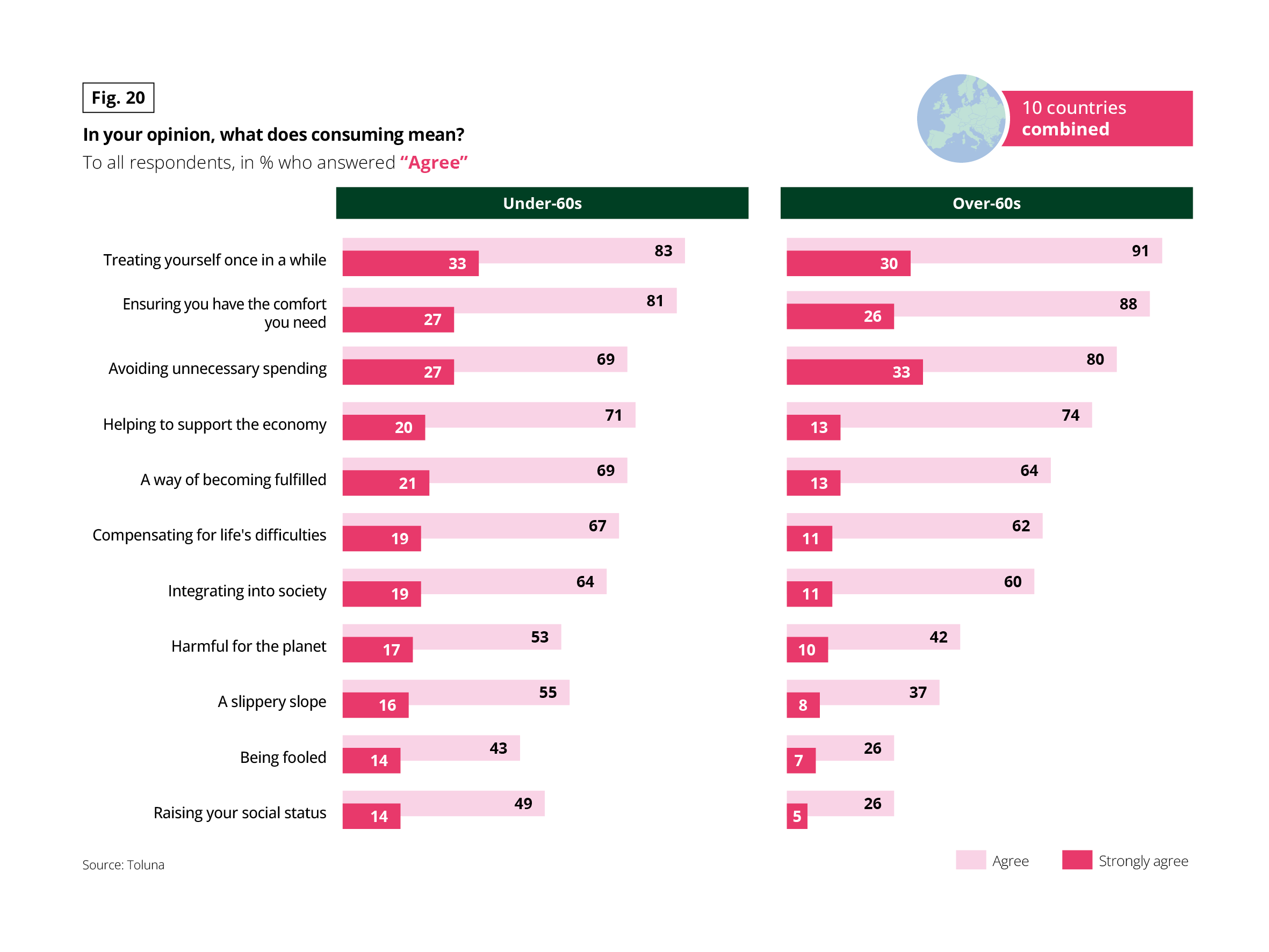 This infographic presents the perceptions associated with consumption, expressed as a percentage of “agree” and “strongly agree” responses, according to two age groups: under 60 and 60 and over.
Under 60 – percentage “agree”: Treat yourself from time to time: 83% Ensure the comfort you need: 81% Participate in supporting the economy: 71% Avoid unnecessary expenses: 69% A way to fulfill yourself: 69% Compensate for life’s difficulties: 67% Integrate into society: 64% An escalation: 55% Harmful to the planet: 53% Show social status: 49% Get ripped off: 43%
60 and over – percentage “agree”: Treat yourself from time to time: 91% Ensure the comfort you need: 88% Participate in supporting the economy: 74% Avoid unnecessary expenses: 80% A way to fulfill yourself: 64% Compensate for life’s difficulties: 62% Integrate into society: 60% An escalation: 37% Harmful to the planet: 42% Show social status: 26% Get ripped off: 26%
The main finding is that positive perceptions of consumption are majority in both groups, with differences according to social or critical dimensions.
Source: Toluna.
This infographic presents the perceptions associated with consumption, expressed as a percentage of “agree” and “strongly agree” responses, according to two age groups: under 60 and 60 and over.
Under 60 – percentage “agree”: Treat yourself from time to time: 83% Ensure the comfort you need: 81% Participate in supporting the economy: 71% Avoid unnecessary expenses: 69% A way to fulfill yourself: 69% Compensate for life’s difficulties: 67% Integrate into society: 64% An escalation: 55% Harmful to the planet: 53% Show social status: 49% Get ripped off: 43%
60 and over – percentage “agree”: Treat yourself from time to time: 91% Ensure the comfort you need: 88% Participate in supporting the economy: 74% Avoid unnecessary expenses: 80% A way to fulfill yourself: 64% Compensate for life’s difficulties: 62% Integrate into society: 60% An escalation: 37% Harmful to the planet: 42% Show social status: 26% Get ripped off: 26%
The main finding is that positive perceptions of consumption are majority in both groups, with differences according to social or critical dimensions.
Source: Toluna.
GETTING INVOLVED TO HELP OTHERS
Thinking about yourself doesn’t mean you can’t think about others. Seniors therefore often devote part of their time to getting involved in a movement or association, or volunteering. In this respect, we need to get away from the common misconception that younger generations are more inclined to navel-gazing, or even selfish.
Whatever the field – sport, culture, associations, politics or even religion – younger people are more involved than their elders, though sometimes with a notable difference. The same is true of volunteering, which under-30s do more of than seniors. It should be noted, however, that involvement increases after the age of 70.
The two Eastern European countries, as well as Portugal and the United Kingdom, stand out for their involvement in the religious sphere, and Sweden for its strong trade union involvement. When it comes to volunteering, France, like Belgium and Spain, stands out from the pack, as demonstrated by the annual success of the Telethon, in which many senior citizens get involved.
Fig 21 – Association participation by age
Download this infographic for your presentations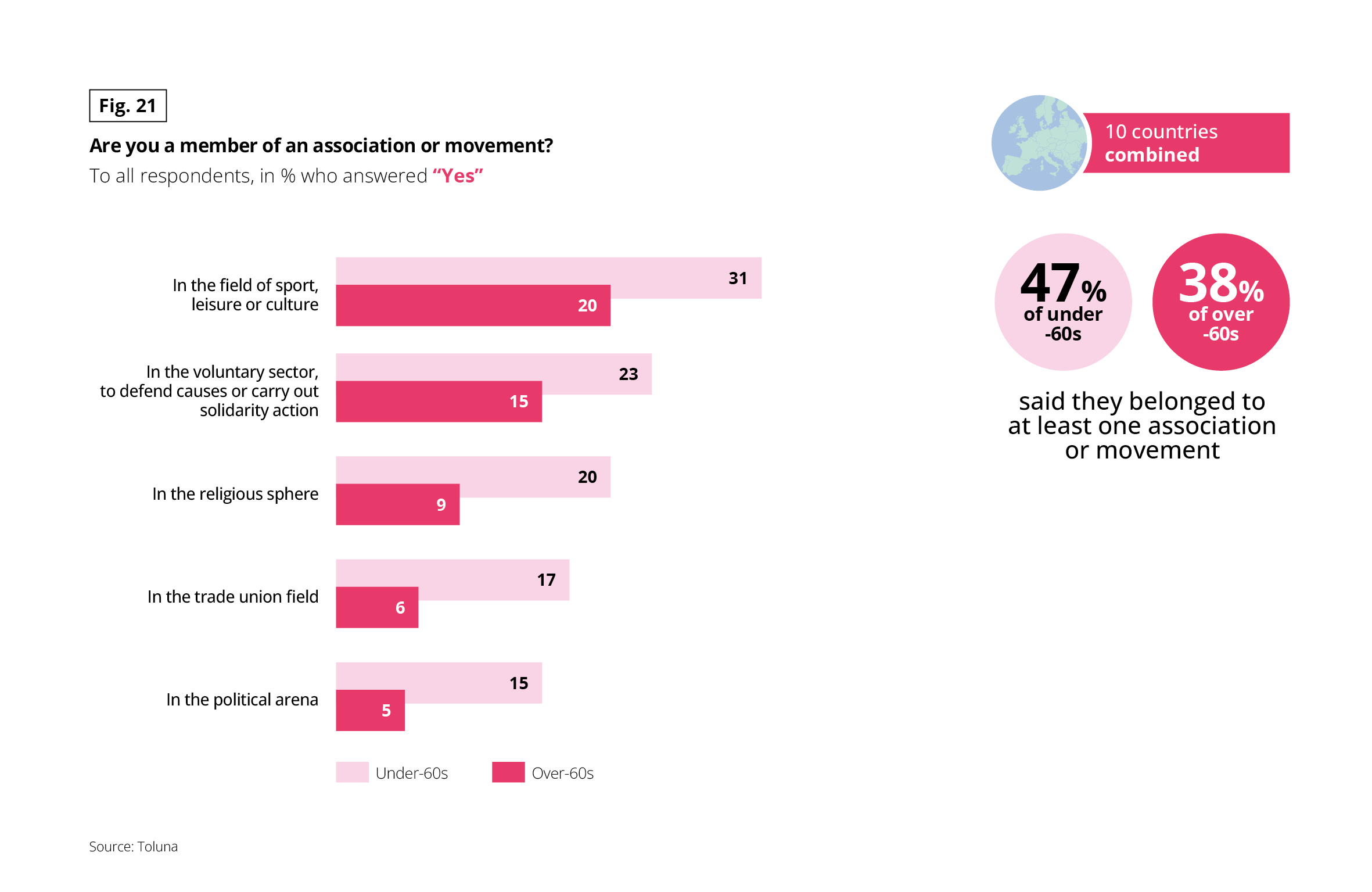 This infographic presents the percentage of people declaring to be part of at least one association or movement.
Under 60: Sports, leisure, or culture: 31% Associative or solidarity: 23% Religious: 20% Union: 17% Politics: 15%
60 and over: Sports, leisure, or culture: 20% Associative or solidarity: 15% Religious: 9% Union: 6% Politics: 5%
Visual summary: 47% of under 60 declare being part of at least one association or movement 38% of 60 and over declare being part of at least one association or movement
Source: Toluna.
This infographic presents the percentage of people declaring to be part of at least one association or movement.
Under 60: Sports, leisure, or culture: 31% Associative or solidarity: 23% Religious: 20% Union: 17% Politics: 15%
60 and over: Sports, leisure, or culture: 20% Associative or solidarity: 15% Religious: 9% Union: 6% Politics: 5%
Visual summary: 47% of under 60 declare being part of at least one association or movement 38% of 60 and over declare being part of at least one association or movement
Source: Toluna.
Les chiffres clés
- For 8 out of 10 Europeans and 9 out of 10 senior citizens ageing in good health is a priority
- 1 in 2 senior citizens believe that reinforcing the healthcare system is a priority
- 4 out of 10 seniors use or are prepared to use digital technology in the near future to help them age in better health
- 8 out of 10 seniors want to remain in their own homes if they lose their independence
- 1 in 2 seniors would prefer to adapt the home they currently live in
- 9 out of 10 seniors want to treat themselves from time to time and are looking for comfort
- 8 out of 10 seniors avoid unnecessary spending