
Genuine brand awareness


 3 min
reading time
3 min
reading time
Against a backdrop of particularly intense market consolidation in recent years, with well-known legacy brands subsumed into groups whose ownership is harder to pinpoint, where do consumers stand? Are brands known, recognised and properly identified? Do they represent a bedrock of trust that drivers can and want to rely on when making a purchase? Is local or regional “made in” status a genuine selling point? The latest Observatoire Cetelem reveals that banking on brand nationality remains a compelling argument, particularly among younger buyers.
NATIONAL BRAND: BORN AND BUILT CLOSE TO HOME
When examining the impact of a brand’s nationality, one must first determine what drivers actually understand by the label. So, what exactly is a “national brand“? While consumers struggle to pick a single defining attribute, they nevertheless draw a clear distinction. A brand’s nationality is not defined by who owns it. Only 15% of respondents take that view.
Instead, nationality is rooted primarily in production (34%) and history (33%), two factors that bestow a concrete, tangible identity. You are where you are born, where you live and where you work. One can also infer that drivers pay little mind (for now, at least) to the financial alliances reshaping the automotive landscape; given the choice between capital and labour, their stance is clear.
Fig. 15 – How do you define the nationality of a brand? (% of respondents)
Download this infographic for your presentations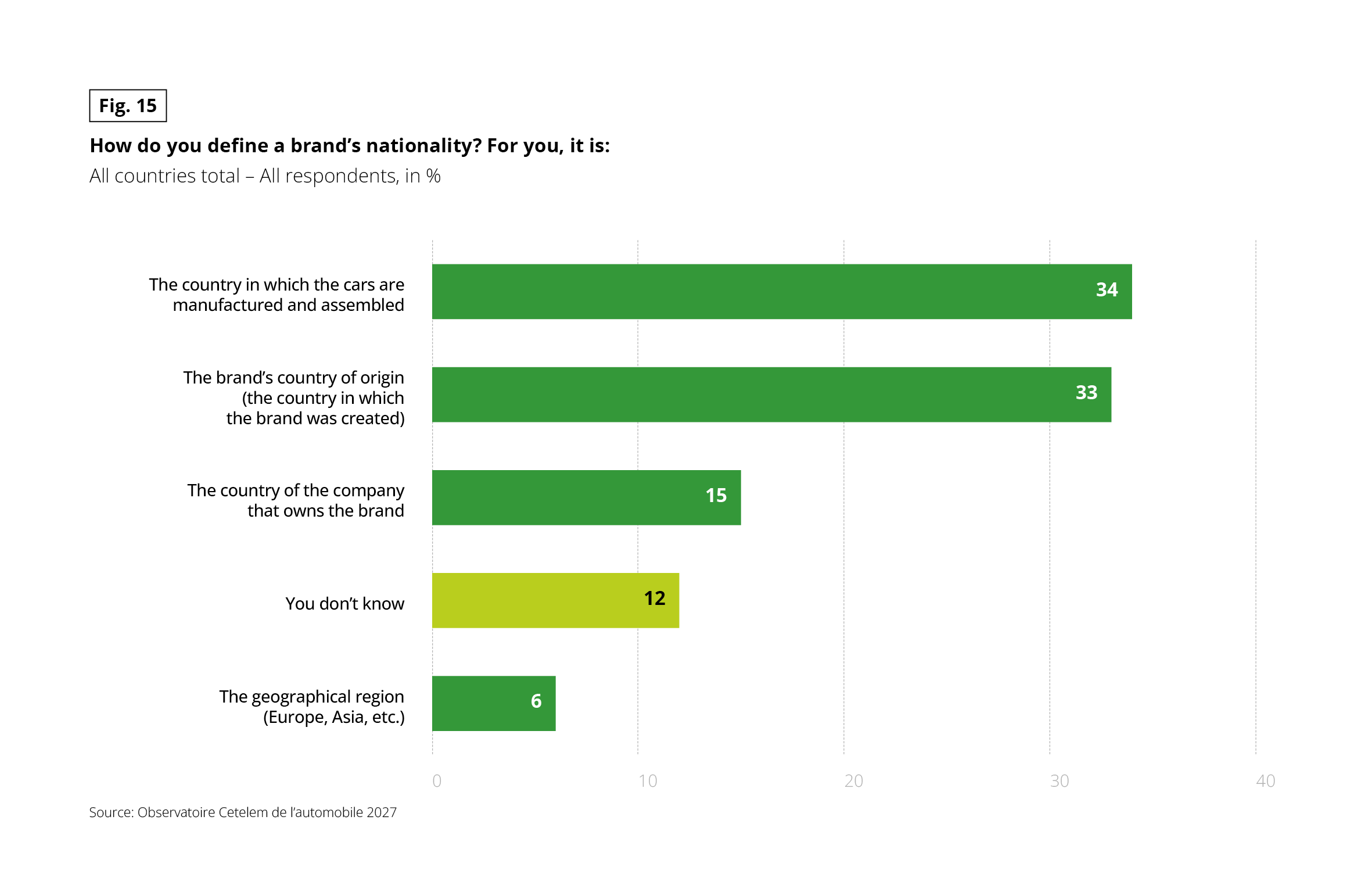 Horizontal bar chart showing how respondents define the nationality of a car brand. All countries total, all respondents, in percent. Source: Observatoire Cetelem de l’automobile 2027.
• The country in which the cars are manufactured and assembled: 34
• The brand’s country of origin (the country in which the brand was created): 33
• The country of the company that owns the brand: 15
• You don’t know: 12
• The geographical region (Europe, Asia, etc.): 6
Key takeaways: place of manufacture and country of origin are cited almost equally and together account for 67% of responses. About one respondent in eight cannot say how a brand’s nationality is defined.
Horizontal bar chart showing how respondents define the nationality of a car brand. All countries total, all respondents, in percent. Source: Observatoire Cetelem de l’automobile 2027.
• The country in which the cars are manufactured and assembled: 34
• The brand’s country of origin (the country in which the brand was created): 33
• The country of the company that owns the brand: 15
• You don’t know: 12
• The geographical region (Europe, Asia, etc.): 6
Key takeaways: place of manufacture and country of origin are cited almost equally and together account for 67% of responses. About one respondent in eight cannot say how a brand’s nationality is defined.
TRADITIONAL BRANDS MORE CLEARLY IDENTIFIED
The Observatoire Cetelem sought to refine its analysis of consumer perceptions. Given that the origins of major share- holder groups do not always match those of their constituent brands, do drivers actually know a brand’s current nationality, and have they grasped any recent changes in ownership structure? Is Volvo still Swedish, Opel German, Jaguar British?
And what of newer entrants such as VinFast? The findings show that legacy European brands are the most accurately identified by nationality, led by the flagships of the German automotive industry. Respondents over the age of 50 demonstrate greater acuity than younger generations. In every country surveyed, respondents occasionally mis- attribute the origins of domestic brands, though “only” 73% of Chinese consumers know BYD is Chinese, and 79% of Americans recognise Ford as American-made. Notably, American consumers show a broader tendency to overestimate the likelihood that any given brand originates from the US.
Fig. 16 – Perceived nationality of 16 car brands (% of most cited response)
Download this infographic for your presentations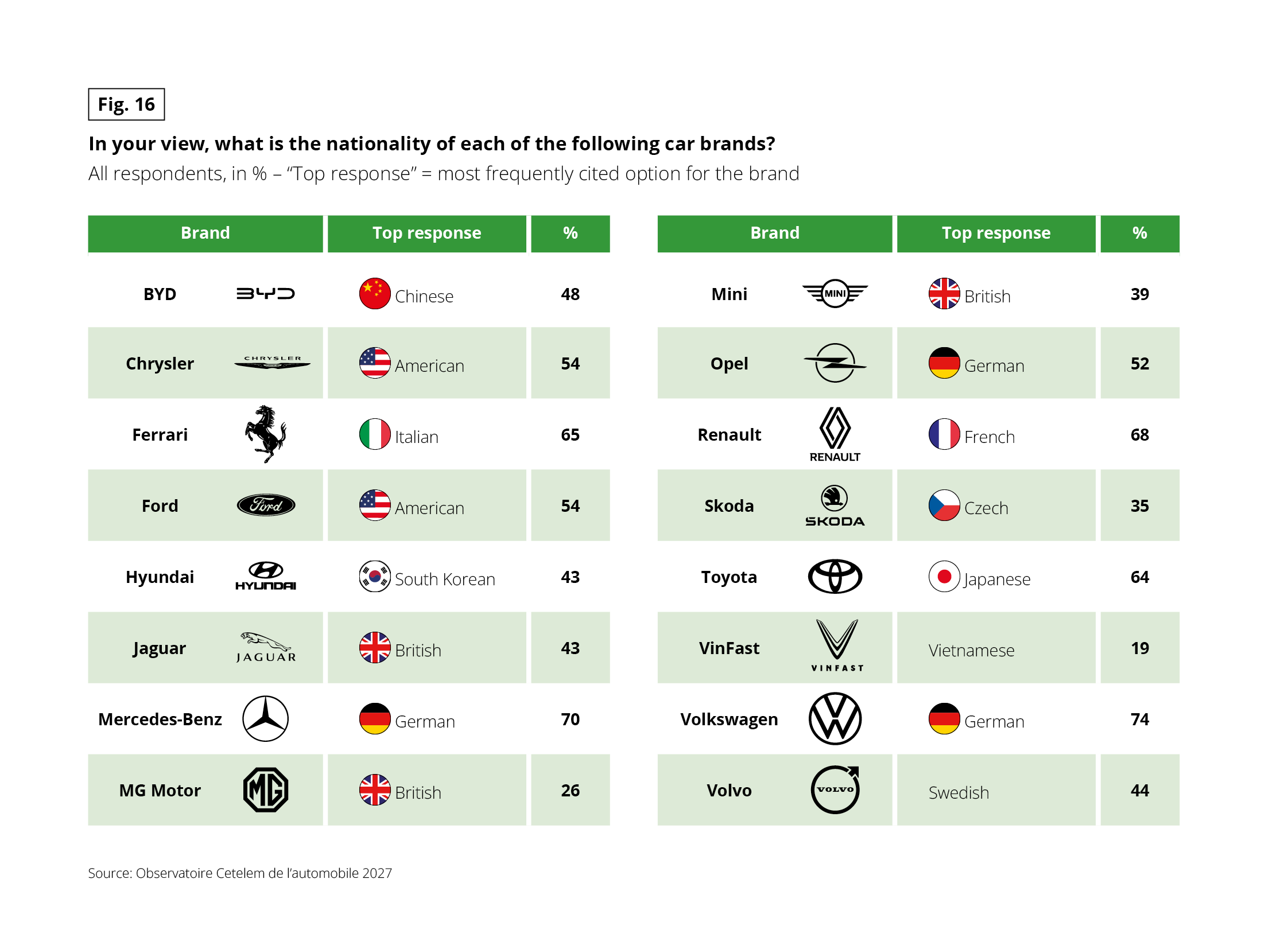 Table showing, for 16 brands, the most frequently cited nationality (“Top response”) and its percentage. It is laid out as two blocks of three columns: brand, top response, %. All respondents, in percent. Source: Observatoire Cetelem de l’automobile 2027.
First block:
• BYD: Chinese, 48%
• Chrysler: American, 54%
• Ferrari: Italian, 65%
• Ford: American, 54%
• Hyundai: South Korean, 43%
• Jaguar: British, 43%
• Mercedes-Benz: German, 70%
• MG Motor: British, 26%
Second block:
• Mini: British, 39%
• Opel: German, 52%
• Renault: French, 68%
• Skoda: Czech, 35%
• Toyota: Japanese, 64%
• VinFast: Vietnamese, 19%
• Volkswagen: German, 74%
• Volvo: Swedish, 44%
Key takeaways: the table gives the most frequent answer, not necessarily the brand’s actual nationality. The most clearly identified brands are Volkswagen (74%), Mercedes-Benz (70%) and Renault (68%); the least are VinFast (19%) and MG Motor (26%).
Table showing, for 16 brands, the most frequently cited nationality (“Top response”) and its percentage. It is laid out as two blocks of three columns: brand, top response, %. All respondents, in percent. Source: Observatoire Cetelem de l’automobile 2027.
First block:
• BYD: Chinese, 48%
• Chrysler: American, 54%
• Ferrari: Italian, 65%
• Ford: American, 54%
• Hyundai: South Korean, 43%
• Jaguar: British, 43%
• Mercedes-Benz: German, 70%
• MG Motor: British, 26%
Second block:
• Mini: British, 39%
• Opel: German, 52%
• Renault: French, 68%
• Skoda: Czech, 35%
• Toyota: Japanese, 64%
• VinFast: Vietnamese, 19%
• Volkswagen: German, 74%
• Volvo: Swedish, 44%
Key takeaways: the table gives the most frequent answer, not necessarily the brand’s actual nationality. The most clearly identified brands are Volkswagen (74%), Mercedes-Benz (70%) and Renault (68%); the least are VinFast (19%) and MG Motor (26%).
PROTECTED DESIGNATIONS OF ORIGIN
Even so, 8 in 10 drivers claim to know the nationality of their vehicle’s brand. Indeed, variations between countries are narrow. The best-informed respondents are found in Japan, Italy and Germany, whereas knowledge is somewhat more patchy in Portugal and the Netherlands. These geographical divides echo patterns observed earlier. Socio-economic distinctions are relatively marked, with men, high earners, those aged over 50 and city dwellers showing the highest levels of awareness.
Fig. 17 – Do you know the nationality of your vehicle’s brand? “yes” response (% of households with at least one car)
Download this infographic for your presentations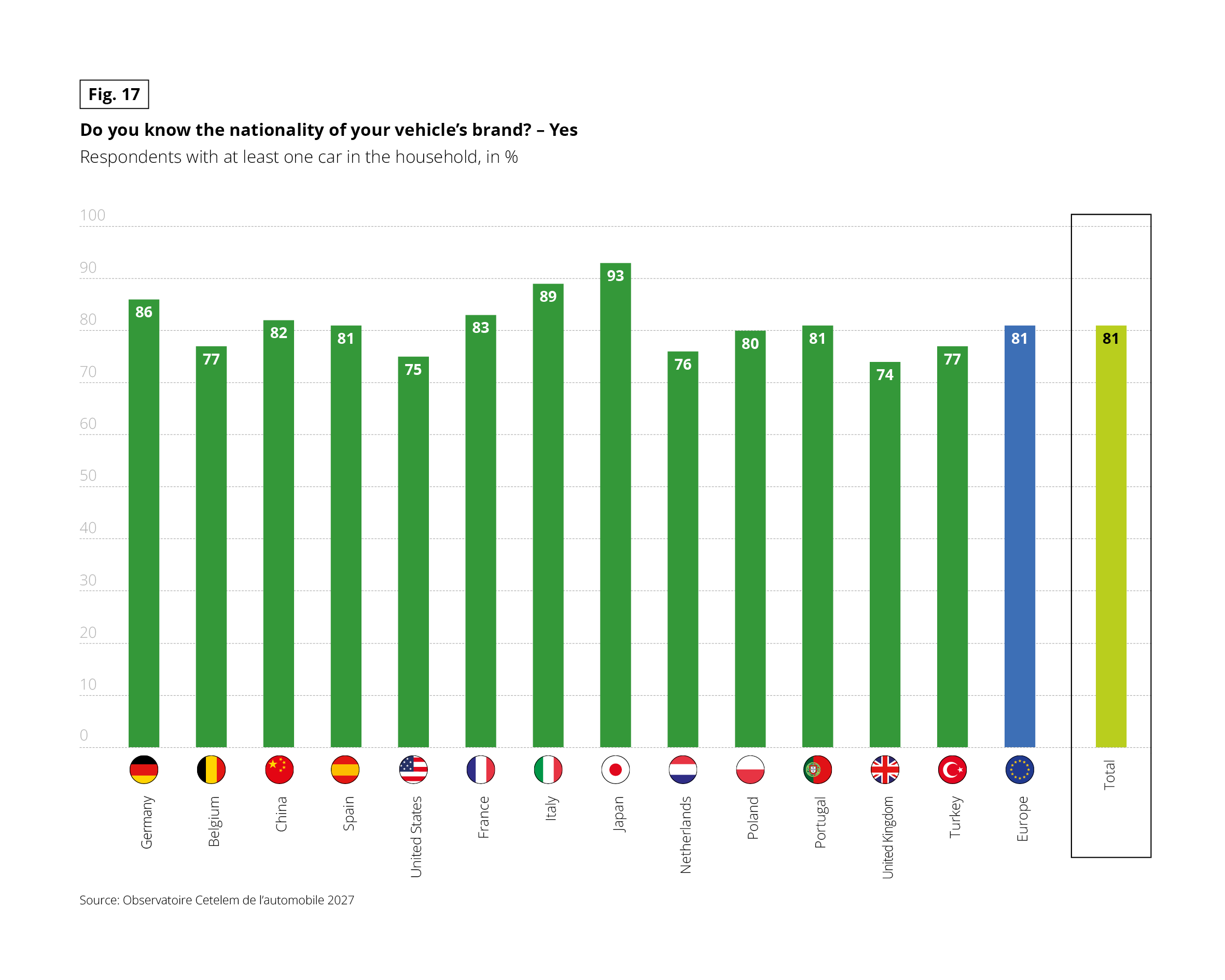 Vertical bar chart showing the share of “Yes” answers to the question “Do you know the nationality of your vehicle’s brand?”, among respondents with at least one car in the household, in percent. The “Europe” bar (81) and the “Total” bar (81) are distinguished from the country bars. Source: Observatoire Cetelem de l’automobile 2027.
• Germany: 86
• Belgium: 77
• China: 82
• Spain: 81
• United States: 75
• France: 83
• Italy: 89
• Japan: 93
• Netherlands: 76
• Poland: 80
• Portugal: 81
• United Kingdom: 74
• Turkey: 77
• Europe: 81
• Total: 81
Key takeaways: awareness of brand nationality is high everywhere (74 to 93%). Japan (93%) and Italy (89%) lead; the United Kingdom (74%) and the United States (75%) are lowest.
Vertical bar chart showing the share of “Yes” answers to the question “Do you know the nationality of your vehicle’s brand?”, among respondents with at least one car in the household, in percent. The “Europe” bar (81) and the “Total” bar (81) are distinguished from the country bars. Source: Observatoire Cetelem de l’automobile 2027.
• Germany: 86
• Belgium: 77
• China: 82
• Spain: 81
• United States: 75
• France: 83
• Italy: 89
• Japan: 93
• Netherlands: 76
• Poland: 80
• Portugal: 81
• United Kingdom: 74
• Turkey: 77
• Europe: 81
• Total: 81
Key takeaways: awareness of brand nationality is high everywhere (74 to 93%). Japan (93%) and Italy (89%) lead; the United Kingdom (74%) and the United States (75%) are lowest.
Fig. 18 – Birth records: founding, countries of origin and group of 10 automotive brands
Download this infographic for your presentations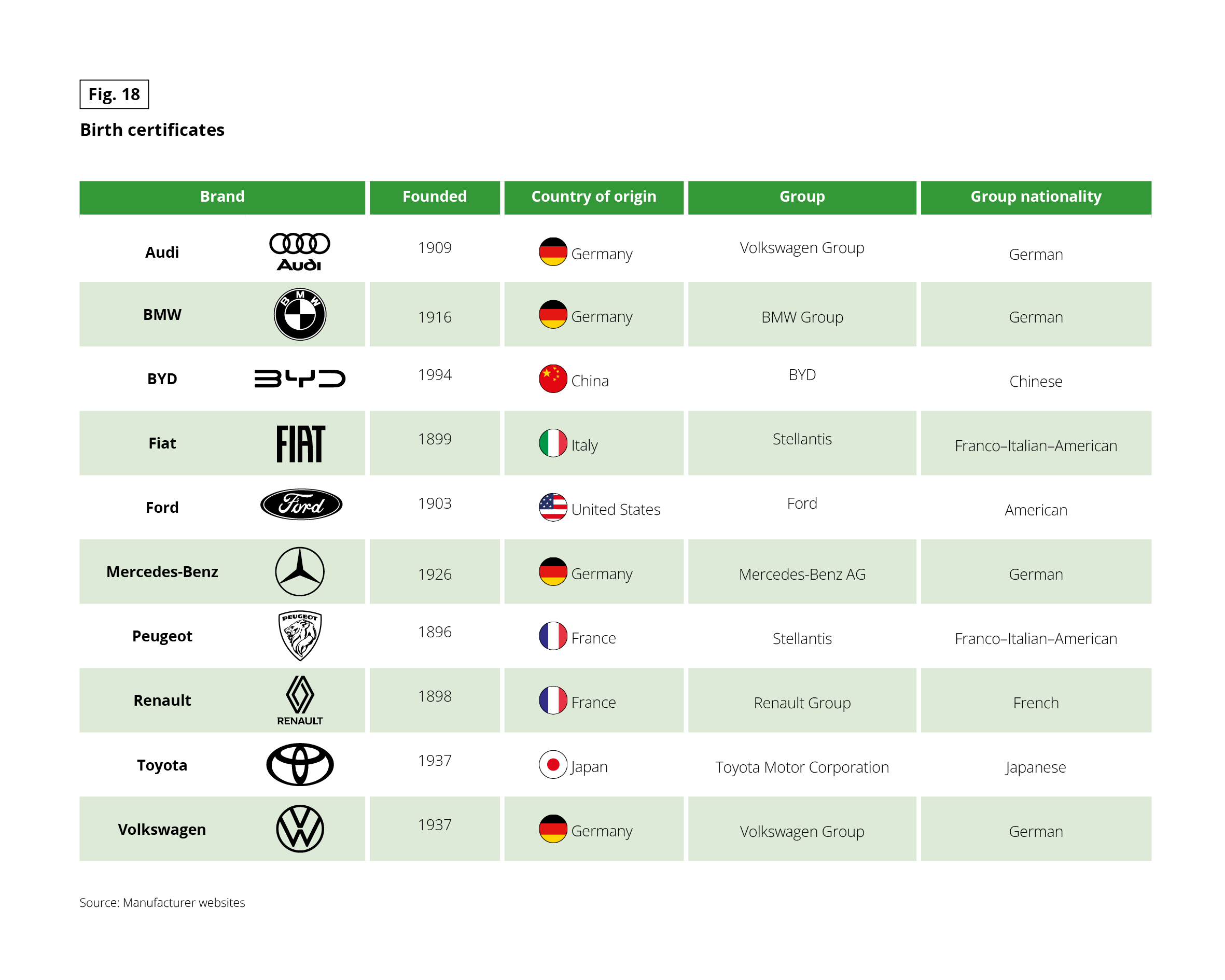 Table with five columns: brand, founded, country of origin, group, group nationality. It has ten rows. Source: manufacturer websites.
1. Audi – 1909, Germany, Volkswagen Group, German
2. BMW – 1916, Germany, BMW Group, German
3. BYD – 1994, China, BYD, Chinese
4. Fiat – 1899, Italy, Stellantis, Franco–Italian–American
5. Ford – 1903, United States, Ford, American
6. Mercedes-Benz – 1926, Germany, Mercedes-Benz AG, German
7. Peugeot – 1896, France, Stellantis, Franco–Italian–American
8. Renault – 1898, France, Renault Group, French
9. Toyota – 1937, Japan, Toyota Motor Corporation, Japanese
10.Volkswagen – 1937, Germany, Volkswagen Group, German
Key takeaways: Peugeot (1896) is the oldest brand in the table and BYD (1994) the most recent. Fiat and Peugeot belong to Stellantis, whose nationality is given as Franco–Italian–American. For the other brands, the group’s nationality matches the country of origin, with one exception noted below.
Table with five columns: brand, founded, country of origin, group, group nationality. It has ten rows. Source: manufacturer websites.
1. Audi – 1909, Germany, Volkswagen Group, German
2. BMW – 1916, Germany, BMW Group, German
3. BYD – 1994, China, BYD, Chinese
4. Fiat – 1899, Italy, Stellantis, Franco–Italian–American
5. Ford – 1903, United States, Ford, American
6. Mercedes-Benz – 1926, Germany, Mercedes-Benz AG, German
7. Peugeot – 1896, France, Stellantis, Franco–Italian–American
8. Renault – 1898, France, Renault Group, French
9. Toyota – 1937, Japan, Toyota Motor Corporation, Japanese
10.Volkswagen – 1937, Germany, Volkswagen Group, German
Key takeaways: Peugeot (1896) is the oldest brand in the table and BYD (1994) the most recent. Fiat and Peugeot belong to Stellantis, whose nationality is given as Franco–Italian–American. For the other brands, the group’s nationality matches the country of origin, with one exception noted below.